 How-to
How to Find an Ayurveda Christian Spiritual Retreat Center
Last Updated: October 29, 2026
Quick Summary
To find an Ayurveda Christian retreat, start by naming your need, faith lines, and realistic length, then screen centers on how honestly they separate Ayurveda's medical and lifestyle tools from its spiritual philosophy. Ask directly who leads Christian reflection and how body practices are framed as care for the temple.
- Write down your need, depth, faith lines, and length before reviewing any center.
- Ask whether Ayurveda is taught as a medical system or a spiritual philosophy.
- Request two or three past guest references from the last year.
- Read the daily schedule and count the free hours for rest.
- Confirm in writing who leads each session and what is included.
Table of Contents
- Start With Your Own Faith and Health Priorities
- How Ayurveda and Christian Reflection Fit Together at a Retreat
- Questions to Ask a Retreat Center Before You Book
- Check Retreat Facilitator Credentials and Training
- Read the Wellness Retreat Schedule Before You Commit
- Where Christian Meditation and Yoga Fit in the Daily Rhythm
- A Side-by-Side Evaluation Checklist for Retreat Centers
- Plan Your Stay at Blisstopia Retreats
- Frequently Asked Questions
Start With Your Own Faith and Health Priorities
Finding an Ayurveda Christian retreat center starts with knowing what you want to change, not with a location. The retreats that stick are matched to a real need, not the prettiest photos.
A clear intention before you book helps a retreat do more than offer a few good days followed by a return to the same patterns. To see how faith-based wellness retreats actually work before searching further, read this overview.
Start here:
- Name the need. Burnout, grief, a faith dry spell, or a body that feels foreign to you.
- Decide how deep you want to go. Rest and renewal differs from structured inner work.
- Set your faith lines. Know which practices feed your Christian walk and which feel off.
Write those four answers down. They become your filter for every center you review.
How Ayurveda and Christian Reflection Fit Together at a Retreat
An Ayurveda Christian retreat blends two traditions without merging them. Ayurveda is an ancient Indian healing system built on diet, daily rhythm, herbal support, and body awareness (Ayurvedic Medicine: In Depth). Christian reflection is the prayer, scripture, and quiet that shapes the soul.
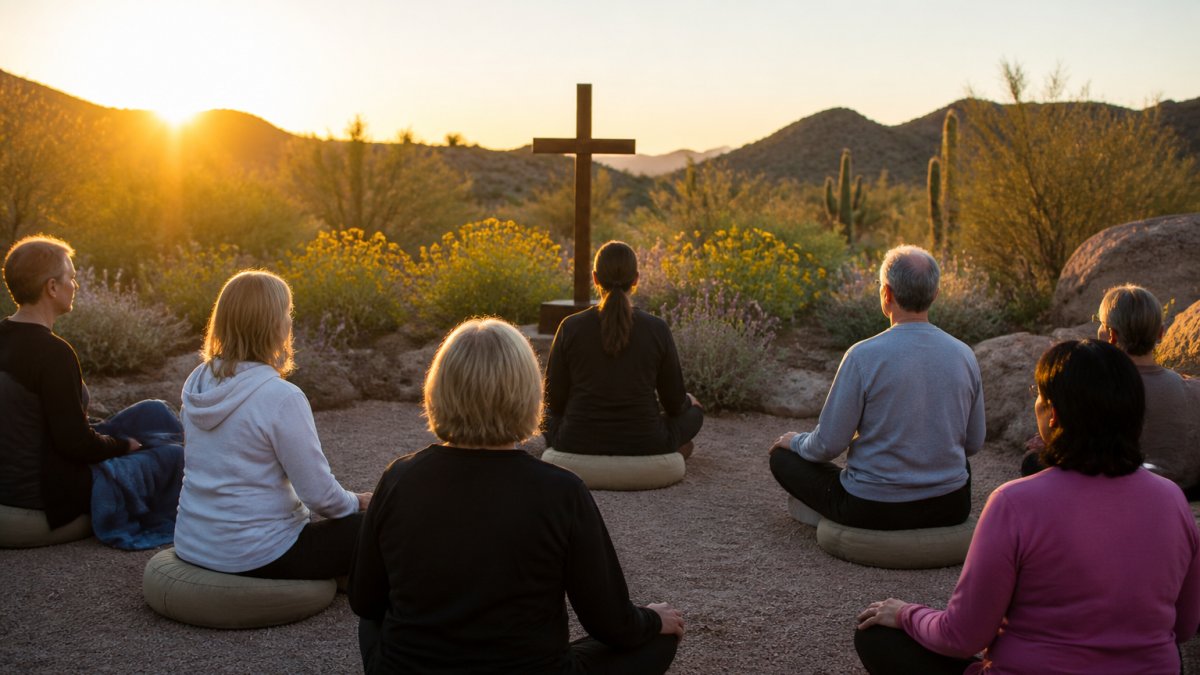
The part most listings skip is the hard question: Ayurveda carries its own philosophical and spiritual framework, and some of it does not sit comfortably with Christian belief.
Where the Two Traditions Actually Meet
In practice, the integration happens at four points, and each one is a place to ask questions:
- Daily rhythm. Ayurveda organizes the day around doshas and natural cycles, early rising, a main meal at midday, wind-down before dark. Christian practice organizes the day around prayer, often morning and evening offices. A strong center shows a schedule where the two reinforce each other rather than compete.
- Food as care. Ayurvedic meals are built around digestion, season, and constitution; Christian practice frames food as gift and fellowship. A center that blesses meals, eats together, and still plates according to Ayurvedic principles is doing real integration.
- Body practices. Yoga, breathwork, and massage are Ayurvedic tools for settling the nervous system; Christian tradition has its own embodied practices, kneeling, fasting, anointing, laying on of hands. Ask whether the center frames body work as care for the temple (1 Corinthians 6:19) or borrows language from outside the tradition.
The Friction Points to Ask About Directly
This is the unique angle most retreat directories avoid. Ayurveda's classical framework includes concepts, doshas, prana, chakras in some lineages, that some Christian guests find helpful as body-language and others find theologically loaded. Neither reaction is wrong. What matters is whether the center is honest about it.
Ask these questions on your first call:
- "Do you teach Ayurveda as a medical and lifestyle system, or as a spiritual philosophy?" The best answer is specific: they separate the two and tell you which parts of the program draw on which.
- "How do you handle concepts like doshas and prana?" A grounded center explains them as frameworks for understanding the body and does not require you to adopt them as belief.
- "Is any practice framed as worship or devotion outside Christian practice?" You want a clear no, or a clear explanation of how the practice is reframed.
- "Who leads the Christian reflection, and are they the same person leading the Ayurvedic sessions?" Separation of roles is often a sign of seriousness.
- "Can I opt out of any session without pressure?" A confident center says yes without hesitation.
What Genuine Integration Looks Like Day to Day
When the blend is real, you can see it in the schedule and the language:
- Morning prayer opens the day before any body work begins.
- Ayurvedic meals are served with intention, often with a short blessing.
- Herbal teas and simple detox routines support the body without replacing medical care.
The best centers are clear about the line. Ayurveda supports the body. Christian reflection shapes the spirit. Neither one claims to do the other's job.
A guide to faith-based desert sanctuaries helps if you want to see how this blend looks across different settings.
Questions to Ask a Retreat Center Before You Book
Ask direct questions and expect direct answers. A center that truly integrates Ayurveda and Christian reflection will welcome the scrutiny. Vague answers are your first warning sign.
Bring this list to every call:
- Who leads the Christian reflection sessions, and what is their background?
- How are Ayurvedic practices adapted for guests who are Christian?
- What does a full day look like, hour by hour?
- Who prepares the meals, and can they handle allergies or restrictions?
- Are any practices optional, and can I skip one without pressure?
- What happens if I have a health issue during my stay?
- Can I talk to a past guest?
How to Verify the Answers You Get
A good answer is not the same as a verified answer. Before you commit, confirm the claims in writing and check them against a second source.
- Credentials. Ask for the certifying body and the hours behind any title. For Ayurvedic practitioners, ask where they studied and for how long, formal programs run from a few hundred to well over a thousand hours. For Christian reflection leaders, ask about seminary or spiritual-direction training and whether they are commissioned or ordained.
- References. A confident center will connect you with two or three past guests from the last year. Ask what a typical day felt like, whether the schedule matched what was promised, and whether they would return.
- What is included. Get meals, sessions, lodging, and any add-on fees spelled out in writing before you pay a deposit. A common pattern is a practice listed as "included" that carries an extra charge at check-in.
Theological Fit and the Retreat's Approach to Christian Practice
Theological fit is the single most important filter, and the one most people skip.
Then listen for how they describe other beliefs. A center grounded in Christian practice will be secure enough to welcome guests who are spiritual but not religious.
If you are weighing silent Christian retreats, these reasons to choose a silent retreat help you judge whether that format fits your temperament.
Medical Safety, Practitioner Qualifications, and Contraindications
Ask who holds the credentials. A trained practitioner should be able to explain what each practice does and who should avoid it.
Tell the center about every medication and condition before you arrive, and check with your own doctor first.
Ask these safety questions:
- Is there a licensed medical professional on call?
- How are herbal supplements sourced and dosed?
- Are fasting or cleansing routines supervised?
A center that cannot answer these clearly is not ready for guests with health concerns.
Check Retreat Facilitator Credentials and Training
Credentials tell you whether the person leading your session has done the work. Ask for specifics, not titles. "Certified" means little without the certifying body and the hours behind it.
Look for:
- Yoga teachers with registered training hours and years of teaching.
- Ayurvedic practitioners with formal study in the tradition.
- Breathwork and meditation leaders trained in trauma-informed methods.
A common mistake is assuming a famous name means a qualified teacher. In practice, the best facilitators explain their training in plain language and name their limits.
At Blisstopia Retreats, our team includes Lana Royce, a psychotherapist with more than 30 years of experience and a 500-RYT yoga teacher who leads our teacher trainings, alongside Mark Royce, a Certified Regenerative Health and Breathwork Coach.
Read the Wellness Retreat Schedule Before You Commit
The wellness retreat schedule is your clearest signal of what the week actually delivers. Read it line by line.
A balanced day usually includes:
- One anchor practice in the morning, such as prayer or meditation
- One body practice, such as yoga or breathwork
- Free time for rest, journaling, or a walk
Count the free hours. Deep renewal needs empty space. If every hour is booked, you are signing up for a busy week, not a restorative one.
Watch out: some schedules list a practice as "included" but charge extra at check-in. Confirm what is covered before you commit.
Where Christian Meditation and Yoga Fit in the Daily Rhythm
Christian meditation and yoga belong in the daily rhythm as care for body and spirit, not as performance.
Ask how each practice is introduced. A center that explains the intent behind every session helps guests from any background feel at ease; one that assumes everyone knows the language will leave newcomers lost.
If silent prayer is part of your daily life, this guide to spiritual growth through silent prayer goes deeper on building the habit.
The rhythm that works best for most guests:
- Morning: prayer or silent meditation before breakfast
- Mid-morning: yoga or breathwork
- Afternoon: rest, nature, or a teaching session
A Side-by-Side Evaluation Checklist for Retreat Centers
Use one checklist for every center so you compare like with like. Score each item from 1 to 5 and total the scores. A center that scores well across the board is worth a call. A center that scores high on beauty but low on safety is not.
| What to Check | Why It Matters | Score (1-5) |
|---|---|---|
| Christian reflection led by a grounded guide | Confirms real theological fit | |
| Ayurvedic practices explained and adapted | Shows the blend is intentional | |
| Practitioner credentials and training | Tells you who is actually leading | |
| Medical safety plan and staff on call | Protects you if something goes wrong | |
| Detailed daily schedule with free time | Reveals the real pace of the week | |
| Clear answers to your booking questions | Signals honesty and good hosting | |
| Reviews from past guests | Shows what the stay felt like |
Two more checks before you commit:
- Ask for references. A confident center will connect you with past guests.
- Confirm what is included. Meals, sessions, and lodging should be spelled out in writing.
Plan Your Stay at Blisstopia Retreats
Blisstopia Retreats is a faith-based wellness sanctuary in the Sonoran Desert.
We custom-build retreats from 3 to 14 days.
If you want to see what a stay actually feels like before you book, read a day in the life of transformation.
The hardest part of finding an Ayurveda Christian retreat is not the search. It is admitting you need one.
Frequently Asked Questions
What should I look for in a Christian wellness retreat?
Look for a retreat that states its faith tradition plainly and explains how prayer, Scripture, and reflection are built into the day. Ask whether facilitators are credentialed in both spiritual direction and the wellness practices they lead. Confirm the schedule leaves room for silence and personal prayer, not just group sessions. A retreat that combines Ayurveda and Christian reflection should also be transparent about how Ayurvedic practices are adapted so they support, rather than replace, Christian worship.
Can Ayurvedic practices fit within a Christian spiritual retreat?
Many retreat centers present Ayurveda as a framework for diet, daily rhythm, herbal therapies, and self-care rather than as a religious system. The key is how the center frames it. Ask whether Ayurvedic recommendations are offered as optional wellness tools alongside Christian prayer and reflection. A well-run Ayurveda Christian retreat will explain its approach up front, keep theological claims out of the wellness programming, and let guests opt out of any practice that conflicts with their convictions.
What questions should I ask a retreat center before booking?
Ask about facilitator credentials, group size, the daily wellness retreat schedule, and how the center handles medical conditions or dietary needs. Request specifics on how Ayurvedic treatments are adapted for Christian participants. Ask for the cancellation policy, what is included in the rate, and whether staff live on site. Also ask for references from past guests and whether the center can share reviews or ratings from people who attended the same program you are considering.
How can I tell whether a retreat's spiritual approach aligns with my beliefs?
Read the center's statement of faith and its description of each retreat program. Ask directly whether prayer, Scripture, and Christian reflection are central or peripheral. Ask how the center handles practices borrowed from other traditions, such as Ayurveda or meditation, and whether guests may decline any session. A short phone call with the facilitator often reveals more than a website. If the answers stay vague, keep looking for a center that speaks clearly about its Christian practice.