 listicle
Spirit in the Desert: Faith-Based Wellness Sanctuary Guide
Table of Contents
- The Spirit in the Desert: Why Arid Landscapes Heal
- What Makes a Faith-Based Wellness Sanctuary Different
- Spiritual Healing Retreats in Arizona: What to Expect
- Inside a Sonoran Desert Retreat Center: Amenities and Setting
- Transportation, Seasons, and What to Pack for the Desert
- Nearby Points of Interest and Nature Immersion
- Booking a Desert Retreat: Group Stays, Individual Visits, and Your Next Step
- Frequently Asked Questions
Last Updated: September 17, 2026
The Spirit in the Desert: Why Arid Landscapes Heal
The spirit in the desert has drawn seekers for centuries, and the reason is not romantic. Desert terrain strips away noise, distraction, and the constant social performance of daily life, leaving space for quiet reflection and spiritual clarity. At Blisstopia Retreats, a faith-based wellness sanctuary in the Sonoran Desert near Peoria, Arizona, that stripping-away is the entire point. This guide covers what a desert retreat actually involves, from amenities and accommodations to transportation, seasons, and how to book.
Deserts have long functioned as places of spiritual formation. The National Park Service's desert ecology resources notes that arid landscapes support ecosystems defined by scarcity and adaptation, and that same scarcity shapes the human experience of the desert: fewer inputs, more attention. Monastic and contemplative traditions across faiths have historically sought out wilderness for exactly this reason. Silence is not empty in the desert; it is full.
Silence, Space, and Spiritual Clarity
Most people arrive at a desert retreat exhausted, not curious. Burnout, grief, and career fatigue follow them through the gate. The desert does not fix that on its own, but it removes the inputs that keep the nervous system braced: traffic, notifications, deadlines, the low hum of other people's expectations.
What happens next is predictable in the best way. Within a day or two, guests often report sleeping more deeply, thinking more slowly, and hearing their own interior voice again. Spiritual guidance, meditation, and mindfulness practices work better in that environment because there is nothing competing for attention. The desert landscape is not a backdrop; it is a co-facilitator.
What Makes a Faith-Based Wellness Sanctuary Different
A faith-based wellness sanctuary is a retreat setting where spiritual practice and holistic healing are offered as one integrated experience rather than two separate tracks. The distinction sounds semantic until you sit inside it. At a conventional wellness resort, a meditation class is a scheduled amenity. At a faith-based sanctuary, that same meditation is framed as a practice of stillness before the divine, and the framing changes how the nervous system receives it.
How Faith and Wellness Actually Integrate
The integration shows up in the sequencing, not the marketing copy. A common pattern at Blisstopia looks like this:
- Morning sadhana opens the day with breathwork and intention-setting rather than a workout.
- Cacao ceremony frames the afternoon's emotional work as a communal, reverent act rather than a wellness trend.
- Sound bath and fire ceremony close the day with release practices drawn from contemplative traditions.
- Cold plunge and infrared sauna support the nervous system so the spiritual work has a body to land in.
Who This Setting Is For, and Who It Isn't
Guests frequently ask whether a faith-based retreat will push them toward a specific doctrine. The honest answer is that these settings vary widely. Some are explicitly denominational. Others, like Blisstopia, hold space for people who describe themselves as spiritual rather than religious, a growing share of the population, as the Pew Research Center's religious landscape research documents.
Spiritual Healing Retreats in Arizona: What to Expect
Spiritual healing retreats in Arizona typically combine structured programming with unstructured desert time, and the balance between the two is what separates a genuine retreat from a spa weekend. A typical day might open with morning sadhana or yoga, move into breathwork or a sound bath, include a shared organic meal, and leave the afternoon open for hiking, journaling, or rest.
Yoga, Breathwork, and Sound Healing
The programming itself is where a retreat earns its reputation. At Blisstopia, retreats blend guided transformational breathwork, sound bath healing, meditation, cacao ceremony, cold plunge, and yoga, alongside Reiki and energy work. Yoga teacher training pathways, including 200-hour and 300-hour certifications and a 50-hour Yin training, run at the same Peoria sanctuary, which means the instruction is led by people who teach teachers rather than by rotating contract staff.
Inside a Sonoran Desert Retreat Center: Amenities and Setting
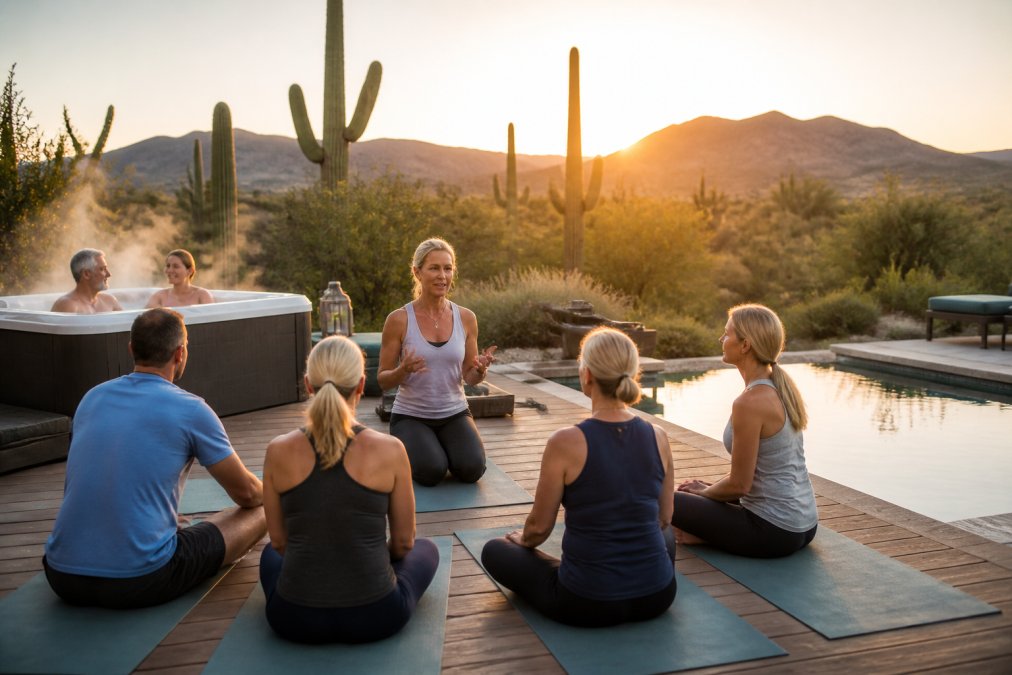
A Sonoran Desert retreat center should feel secluded without feeling remote, and the setting does much of the work. Blisstopia's roughly 7,000 square foot villa sits on 2.5 off-grid acres at the base of Sunrise Mountain, powered by well, septic, solar, and propane. That self-sufficiency is not a marketing detail; it is why the property stays quiet.
Accommodations and Group Capacity
Lodging covers 5 bedrooms, 6 baths, and 17 beds, which makes the property well suited to group retreats while still allowing individual stays. For facilitators considering hosting, that capacity comfortably handles a group of 12 to 15 without the high-touch feel collapsing, partly because Mark and Lana Royce live on-site in the Casita adjacent to the villa and stay present throughout.
Transportation, Seasons, and What to Pack for the Desert
Getting to a desert retreat near Peoria, Arizona is straightforward: the property sits roughly an hour's drive from Phoenix Sky Harbor International Airport, and a rental car is the most practical option for most guests. Rideshare coverage thins out considerably once you leave the metro area, so arrange your final leg in advance rather than assuming a driver will be available at the gate.
| Season | Typical Conditions | What to Pack |
|---|---|---|
| Spring (Mar-May) | Warm days, cool nights, peak wildflower season | Layers, light jacket, sun hat, closed-toe shoes |
| Summer (Jun-Aug) | Intense heat, early monsoon storms | Linen clothing, refillable bottle, rain shell |
| Fall (Sep-Nov) | Mild days, cool evenings, clearest skies | Light layers, sweater, hiking shoes |
| Winter (Dec-Feb) | Cool days, cold nights, occasional frost | Warm jacket, hat, gloves for early mornings |
Nearby Points of Interest and Nature Immersion
Nature immersion around Peoria extends well beyond the property line, and building in a day trip or two is worth the planning. The Arizona State Parks trails and recreation guide lists maintained trail systems across the region, and the surrounding Sonoran Desert landscape offers hiking, wildlife viewing, and stargazing that city guests rarely get at home.
Booking a Desert Retreat: Group Stays, Individual Visits, and Your Next Step
Most top-ranking retreat pages stop at 'contact us to book.' That is the gap this section fills: what the booking conversation actually involves, how far ahead to start it, and how group and individual paths diverge.
Timing: When to Inquire
Advance booking is the norm, and peak season fills first. Blisstopia's Peoria property is typically rented mid-April through May, so facilitators planning a spring event should start the conversation well ahead of that window, think months, not weeks. Individual retreats, women-only retreats, men's day retreats, couples' workshops, and teacher training immersions all run through the same inquiry path, but the lead time each requires varies.
What the Inquiry Conversation Covers
The booking process is conversational rather than transactional, and that is deliberate. A good facilitator needs context before they can build a sequence that fits. Expect the inquiry to cover:
- Your goal. Burnout recovery, grief work, a couples' reset, and teacher development each call for different programming.
- Your group size and composition. Individual stays, women-only groups, men's cohorts, and couples all have different container needs.
- Your dates and flexibility. Peak-season windows are tight; off-season dates open more options.
- Your experience level. First-time retreat guests and seasoned practitioners are welcomed differently.
- Your logistics. Arrival timing, dietary needs, and any accessibility considerations.
Group Stays vs. Individual Visits
Group facilitators have a distinct path. The property's three hosting models, Solo Rental (venue only), Partial Collaboration (venue plus curated meals and sessions), and Full Partnership (shared theming, marketing, and profit-sharing after expenses), are covered in the amenities section above. Facilitators can choose the model that best matches their logistical needs.
Your Next Step
Reach out to Blisstopia Retreats to discuss current offerings, availability, and which retreat or hosting model fits what you are actually going through. Call 623-986-2899 to start that conversation.
Frequently Asked Questions
What is the spiritual significance of the desert?
Desert landscapes have long been seen as places of spiritual clarity. The silence, open space, and lack of distraction create room for reflection and renewal. In many traditions, the desert is where people go to hear themselves think and reconnect with what matters most. A faith-based wellness sanctuary in the Sonoran Desert uses this natural setting to support meditation, mindfulness, and personal transformation.
Where can I find spiritual healing retreats in Arizona?
Arizona has a range of spiritual healing retreats, from day programs to multi-day immersions. Look for centers that offer guided breathwork, sound healing, meditation, and yoga, and that sit in quiet natural settings. Blisstopia Retreats, a faith-based wellness sanctuary near Peoria at the base of Sunrise Mountain, hosts retreats for men, women, and couples with on-site caretakers and all-inclusive stays.
What should I look for in a faith-based wellness sanctuary?
Check whether the center is open to different beliefs or pushes one specific faith. Ask about facilitator credentials, on-site support, and whether programming is customized to your needs. A good sanctuary offers quiet reflection, nature immersion, and a peaceful setting without judgment. Blisstopia operates as a private membership association with on-site caretakers and over 75 years of combined experience between its founders.
How do desert retreats facilitate personal transformation?
Desert retreats combine silence, nature immersion, and structured wellness practices to help people step away from daily noise. Guided breathwork, meditation, sound bath healing, and time in the desert landscape create space for clarity and emotional release. Shorter stays of three to four days can still deliver meaningful shifts, especially when programming is intentional and facilitators are experienced.