 listicle
Grace in the Desert: Faith-Based Wellness Retreats
Table of Contents
- What Does Grace in the Desert Mean?
- A Faith-Based Wellness Sanctuary in the Sonoran Desert
- Spiritual Desert Retreats for Burnout and Transition
- Desert Healing Rituals That Anchor the Experience
- Who Finds Grace in the Desert, and How to Choose the Right Retreat
- Frequently Asked Questions
Last Updated: September 20, 2026
What Does Grace in the Desert Mean?
Grace in the desert is the experience of receiving unearned kindness, clarity, and renewal in a landscape that strips away distraction. The phrase carries both a theological weight and a practical one, and the two are more connected than most people realize. This guide from Blisstopia Retreats explores what that phrase means, why desert settings produce transformation so reliably, and how to choose a faith-based wellness sanctuary that delivers it.
Most pages that rank for this phrase are directory listings, a church name, an address, a service time. Almost none of them explain where the phrase comes from or why it has held meaning for thousands of years. That is the gap this section fills.
Where the Phrase Comes From
The idea behind "grace in the desert" is older than the English wording. In the Hebrew scriptures, the wilderness is not a punishment, it is a classroom. The book of Exodus describes a people led out of slavery and into open country where they have no food, no water, and no plan. What they receive there is manna: bread that appears on the ground each morning, cannot be stored, and cannot be earned. Theologians have pointed to that detail for centuries. Provision that arrives daily and cannot be hoarded is grace in its purest form, you receive it, you depend on it, and you cannot turn it into a possession.
That pattern repeats. Elijah is fed by ravens in a dry streambed. John the Baptist preaches in the wilderness. Jesus is tested in the desert before beginning his public work. The desert is consistently the place where people are stripped down, and then met.
the Oxford Research Encyclopedia entry on desert spirituality traces how early monastic communities in Egypt and the Near East deliberately sought deserts for exactly this reason. The environment made inner work unavoidable. Silence, heat, and scarcity did not create holiness, they removed the buffers that let a person avoid what was already there.
The Metaphor Beyond Religion
You do not have to read the phrase theologically to find it useful. A "desert" in ordinary life is any season where the usual sources of comfort run dry: a career that has lost meaning, a marriage that has gone quiet, a body that has stopped cooperating, a faith that no longer answers. Most people arrive at a retreat during one of those seasons, whether or not they would use the word "desert."
The metaphor matters because it reframes the experience. A desert is not a failure state. It is a place where the usual supports are absent, which means whatever sustains you there is something you did not manufacture. That is the definition of grace, unearned, unplanned, and often unrecognized until later.
The Spiritual Significance of Desert Landscapes
Heat, silence, and open horizon do something to a person that a spa treatment cannot. The desert removes comfort as a buffer. Without constant noise and stimulation, what you have been avoiding tends to surface.
Many retreat guests describe the same sequence: restlessness for the first day, then grief or anger, then a quiet they had not felt in years. That quiet is the point.
Grace as an Active Practice, Not a Passive Gift
A common mistake is treating grace as something you simply wait to receive. In practice, grace tends to arrive when someone creates the conditions for it: stillness, honesty, community, and time away from ordinary demands.
That reframing matters because it puts agency back in your hands.
A Faith-Based Wellness Sanctuary in the Sonoran Desert
A faith-based wellness sanctuary is a private setting where spiritual practice, rest, and therapeutic care are woven together rather than sold separately. Blisstopia Retreats operates exactly this way on 2.5 secluded acres at the base of Sunrise Mountain, near Peoria, Arizona. Physical movement serves as a vital component of this holistic restoration, grounding the spirit through structured faith-based fitness programs that align bodily exertion with intentional prayer.
What a Private Membership Association Means for Guests
A Private Membership Association is a private membership structure that allows a ministry to hold sacred and transformational practices within a religious and spiritual wellness framework, rather than operating as a standard commercial business. Blisstopia operates as an unincorporated tax-exempt religious ministry under 26 U.S.C. Section 508(c)(1)(a).
Spiritual Desert Retreats for Burnout and Transition
Spiritual desert retreats work best for people in transition: the executive considering leaving a career, the parent whose children just left home, the couple who has drifted, the yoga teacher ready to teach differently. Burnout is not a spa problem, and it does not respond to a massage and a smoothie.
What a Typical Retreat Day Looks Like
A typical day moves between structured practice and open space:
- Morning sadhana, meditation, or breathwork before breakfast
- A nourishing organic meal, often built around Ayurvedic principles
- Mid-morning yoga, hiking, or a teaching session
- Afternoon sound bath, energy work, or free time by the pool
- Evening cacao ceremony, fire circle, or restorative practice
- Cold plunge and hot tub available throughout
Desert Healing Rituals That Anchor the Experience
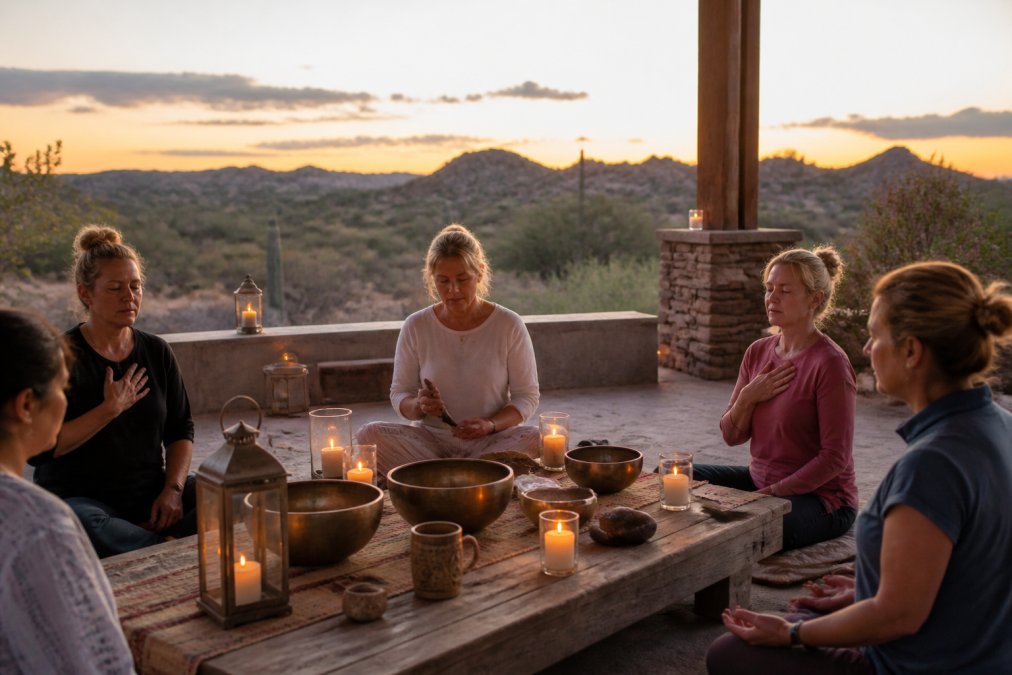
Desert healing rituals are the practices that turn a beautiful property into an actual transformation. Blisstopia's retreats blend guided breathwork, sound bath healing, meditation, cacao ceremony, cold plunge, and organic meals into a single arc.
Breathwork, Sound Baths, and Cacao Ceremony
Breathwork is the anchor practice, and it is where beginners are often most surprised. Box breathing with an extended retention count, meridian line tapping, and lymphatic movement sessions are taught in ways first-timers can follow.
Who Finds Grace in the Desert, and How to Choose the Right Retreat
Grace in the desert finds different people for different reasons. Women in their fifties who have poured decades into everyone else. Men ready to break generational patterns. Couples who want to reconnect. Yoga teachers seeking advanced training. Professionals at a breaking point who need more than a vacation.
Faith-Based, Spiritual-But-Not-Religious, or Secular: What the Difference Actually Means
Search results for this phrase mix several very different kinds of places, and the labels are not interchangeable.
Matching Format to Need
| If you are... | Look for... | Format that fits |
|---|---|---|
| Deeply burned out | Trained facilitators on-site overnight | 5-7 days |
| Short on time | A theme-focused weekend | 3-4 days |
| Spiritual but not religious | Open, non-dogmatic framing | Any length |
| A yoga teacher | Advanced training with mentorship | Immersion plus virtual modules |
| Hosting your own group | Flexible venue partnership | Custom |
| In grief or transition | Smaller groups, longer stays, on-site founders | 5-14 days |
A useful rule of thumb: the deeper the burnout or grief, the longer the stay needs to be. A weekend can interrupt a downward spiral. Rebuilding routines and identity usually takes a week or more, because the first two or three days are spent simply coming down from ordinary life.
Questions Worth Asking Before You Book
- Who is physically present overnight, and are they trained?
- How large is the group, and is it capped?
- Is the theology explicit, optional, or absent?
- What happens if a session brings up something heavy?
- Is the property private, or shared with other guests?
- What is included, and what is added on later?
Blisstopia offers several distinct retreats, including Raw & Wild, a women's retreat led by Geli Ulku; Lit Within, led by spiritual guide and intuitive energy healer Emily Ellenberger; the Soul Vortex Retreat, a five-day journey with a Sedona excursion; and Lifting Up the Brotherhood of Men, a day retreat for men. The Kundalini Fusion Method™ teacher training runs January 21-25, 2027, with 48 hours of in-person immersion plus 52 hours of virtual integration.
Frequently Asked Questions
What is the spiritual desert, and why does it matter for personal transformation?
The spiritual desert is a metaphor for seasons of stillness, stripping away, and waiting. Faith traditions describe the desert as a place where distractions fall away and people encounter what matters most. In practice, a literal desert setting supports that same inward work: quiet, open sky, and few interruptions. A faith-based wellness sanctuary uses that environment intentionally, pairing silence and solitude with guided practices so the metaphor becomes lived experience rather than abstract theology.
How can spiritual desert retreats help with burnout or a major life transition?
Burnout and transition both involve carrying too much for too long. Spiritual desert retreats interrupt that pattern by removing daily obligations and replacing them with structured rest, guided breathwork, meditation, and honest conversation. Guests often arrive considering a career change, a relationship shift, or grief work. The desert does not solve those problems, but the space and facilitation let people hear their own answers. Shorter stays of three to four days can still produce clarity; longer stays allow deeper processing.
What should I expect from a faith-based wellness retreat in the desert?
Expect a blend of spiritual practice and practical care: morning meditation or yoga, guided breathwork, sound bath healing, nourishing meals, and free time for hiking or reflection. Faith-based does not mean pressured. At Blisstopia Retreats, for example, guests of any belief background are welcome, and practices are offered rather than imposed. Accommodations, meals, and sessions are typically included, and hosts live on-site. Ask what is included and how much unstructured time you will have before you book.
What are desert healing rituals, and do I need experience to take part?
Desert healing rituals include sound bath healing, cacao ceremony, guided breathwork, fire ceremony, and meditation in natural settings. They are gentle and guided, and no prior experience is required. Participants sit, breathe, listen, and reflect. If a practice does not suit you, you can simply observe. The point is not performance but presence. Ask the retreat host which rituals are scheduled and whether any involve physical exertion so you can prepare accordingly.