 How-to
How to Find a Quiet Faith-Centered Space for a Team Retreat
Last Updated: October 30, 2026
Quick Summary
Find a faith-centered retreat by confirming the venue offers exclusive use of the property, on-site caretakers, and built-in silence, prayer, and rest. Ask every venue the same written questions about privacy, meals, safety, accessibility, and cancellation terms before you sign anything.
- Confirm exclusivity in the contract so no second group shares the property during your stay.
- Cap structured sessions at two per half-day and protect one full free block daily.
- Get deposit, cancellation, exclusivity, and force majeure terms in writing before signing.
- Ask who the on-site facilitator is and what credentials they hold.
- Collect dietary, accessibility, and medication notes from every guest five weeks out.
Table of Contents
- What a Quiet, Faith-Centered Retreat Space Actually Requires
- Your Healing Retreat Planning Checklist Before You Contact Anyone
- Retreat Venue Questions to Ask Before You Sign Anything
- Private Team Retreat Requirements: Group Size, Privacy, and Facilities
- Choosing a Wellness Retreat With Accommodations and Meals Included
- A Seven-Day Team Retreat Schedule Template That Leaves Room for Rest
- Healing Retreat Safety, Accessibility, and Transparent Booking Terms
- Inquire About Hosting Your Team at Blisstopia Retreats
- Frequently Asked Questions
What a Quiet, Faith-Centered Retreat Space Actually Requires
Finding a faith-centered retreat that can hold a whole team in silence, prayer, and rest takes more than a pretty listing.
Quiet is not a feature you add at the end. It is a design decision made long before your group arrives.
Three things separate a truly quiet venue from a loud one with a chapel sign:
- Distance from noise. The property sits away from highways, event venues, and shared walls.
- Built-in rhythm. Prayer, reflection, and rest are part of the daily flow, not add-ons.
- On-site care. Someone lives there and guards the group's peace.
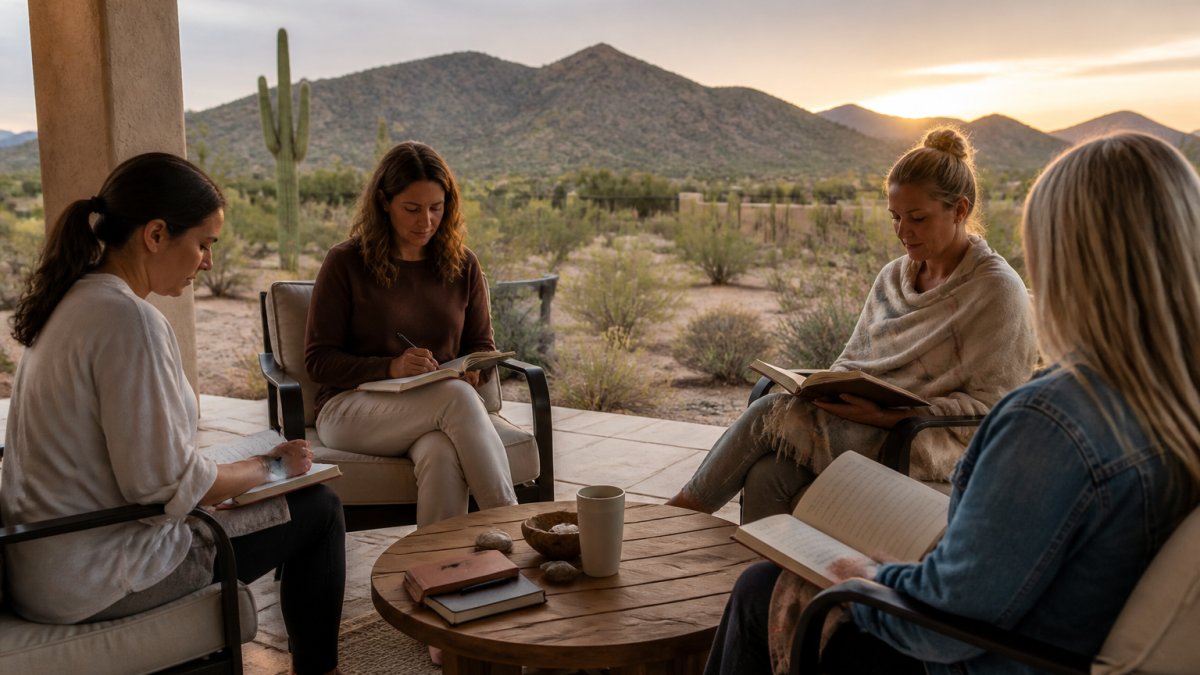
Silence, Prayer, and Reflection Built Into the Property
Silence has to be physical before it can be spiritual. Look for real separation: a private driveway, no shared facilities, and no neighboring groups booked at the same time.
Ask whether the property has a dedicated quiet zone.
If you want to see how a desert sanctuary builds this kind of stillness into its grounds, read about faith-based wellness retreats in the desert.
Spiritual Programming That Welcomes Mixed Levels of Faith
Your team will not arrive with the same beliefs. A good faith-centered retreat welcomes everyone without pushing anyone. Look for programming that offers invitation, not pressure:
- Optional prayer and worship sessions
- Guided reflection and journaling
- Space for people who are spiritual but not religious
Your Healing Retreat Planning Checklist Before You Contact Anyone
A healing retreat planning checklist saves you weeks of back-and-forth. Get your own house in order before you call a single venue, prepared teams ask sharper questions and book faster.
Work through this list first:
- Confirm your group size and how many rooms you need
- Set your dates and a backup week
- Agree on a budget range and who approves it
If this is your first time organizing a group stay, a structured retreat hosting logistics plan can walk you through the steps before you reach out.
Retreat Venue Questions to Ask Before You Sign Anything
The right retreat venue questions are the ones that protect your team later.
Ask each venue directly:
- Will any other group share the property during our stay?
- Who lives on-site, and how do we reach them?
- Can we see a sample schedule for a full week?
- What happens if a guest needs medical help?
- Are meals included, and can you handle dietary needs?
- What are the deposit and cancellation terms in writing?
- Can we customize the programming for our group?
Get the answers in writing. A venue that hesitates on privacy or cancellation terms is telling you something.
Watch out: a venue that promises "exclusive use" but books a second group in a separate wing will quietly break the silence you paid for. Confirm exclusivity in the contract.
Private Team Retreat Requirements: Group Size, Privacy, and Facilities
Private team retreats live or die on three things: group size, privacy, and facilities. Match the venue to your headcount before you fall in love with the photos.
| Requirement | What to Confirm | Why It Matters |
|---|---|---|
| Group size | Beds and rooms for everyone | Prevents cramped or split lodging |
| Privacy | Exclusive use of the property | Protects silence and trust |
| Gathering space | A room for the whole group | Keeps sessions together |
| Breakout space | Small rooms or outdoor nooks | Supports small-group healing work |
| Facilities | Kitchen, baths, quiet zones | Covers daily comfort and rest |
A private booking also protects group cohesion. Teams that share one space, one table, and one schedule build trust faster than teams scattered across a hotel. For more, see the benefits of private wellness retreats.
Gathering Spaces, Lodging, and Room Configuration
Walk through the room setup before you commit. Ask how many beds are in each room, whether anyone shares a bathroom, and where the group will meet each morning.
Review the actual accommodations and room layouts to see whether the configuration fits your team size.
Choosing a Wellness Retreat With Accommodations and Meals Included
A wellness retreat with accommodations and meals included removes the daily friction that drains a group. If you are weighing venues that bundle lodging and food, this guide to all-inclusive spiritual retreats explains what those packages typically cover.
Confirm that these are truly included:
- Lodging for every guest
- Meals, with dietary options
- Snacks and drinks between sessions
Watch out: "meals included" can mean a bare continental breakfast. Ask for a sample menu and confirm how many meals per day are covered. Get the exact list in writing.
A Seven-Day Team Retreat Schedule Template That Leaves Room for Rest
A team retreat schedule template keeps the week intentional without overfilling it. The best seven-day plan has open space built in. Rest is not the reward at the end. It is the method.
Most planners fill Day 1 with sessions and hope the group has energy left by Day 7. Accounting for the logistical friction of travel ensures that your schedule remains realistic, which requires careful consideration of transport for remote teams to prevent exhaustion before the retreat even begins.
The Planning Timeline: Eight Weeks Out to Departure
Planning a seven-day retreat takes lead time. Allow several weeks before departure to settle the details:
| When | What to Lock Down |
|---|---|
| 8 weeks out | Confirm dates, group size, budget range, and one decision-maker; request written quotes from two or three venues |
| 6 weeks out | Sign the venue agreement; confirm exclusivity, deposit terms, and cancellation policy in writing |
| 5 weeks out | Collect dietary needs, accessibility needs, and medication or mobility notes from every guest |
| 4 weeks out | Draft the daily flow; assign facilitators; confirm meals, snacks, and quiet hours |
| 3 weeks out | Send the pre-retreat packet: packing list, schedule overview, opt-out policy, emergency contacts |
| 2 weeks out | Confirm arrival logistics, room assignments, and on-site contact; walk through the medical emergency plan |
| 1 week out | Final headcount to the venue; print schedules and journals; brief the co-lead on group dynamics |
| Departure week | Arrive early if possible; hold a 30-minute facilitator huddle before guests arrive |
This timeline is not rigid. The point is that the schedule, the meals, and the quiet hours are all decided before anyone packs a bag.
The Seven-Day Flow
Here is a simple framework to adapt:
| Day | Focus | Sample Flow |
|---|---|---|
| Day 1 | Arrival and grounding | Settle in, welcome circle, early rest |
| Day 2 | Reflection | Morning prayer, breathwork, journaling |
| Day 3 | Healing work | Guided sessions, quiet afternoons |
| Day 4 | Rest and nature | Free morning, outdoor time, evening circle |
| Day 5 | Connection | Small-group work, shared meals, worship |
| Day 6 | Integration | Reflection, planning, closing ceremony |
| Day 7 | Departure | Gentle send-off, travel home |
Pacing Rules That Protect the Group
A schedule is only as good as the rules that hold it. Four pacing rules do most of the work:
- Cap structured sessions at two per half-day. A morning session and an afternoon session is plenty. The space between them is where the healing lands.
- Protect one full free block per day. Day 4 is the obvious candidate, but even Days 2 and 3 should have a two-hour open window.
- Front-load rest, not content. Day 1 should end early. A tired team cannot absorb a heavy opening session, and a rushed arrival sets a tense tone for the week.
What to Leave Out
A seven-day retreat tempts organizers to add more workshops, speakers, and excursions. Resist it. A rested team will do deeper work in half a day than a tired team will do in three.
If you are still choosing a venue, the retreat venue questions to ask before you sign anything will help you confirm the property can hold this rhythm.
Healing Retreat Safety, Accessibility, and Transparent Booking Terms
Healing retreat safety and clear booking terms protect both your team and your peace of mind. Ask about these before you sign, and get the answers in writing.
Emotional Safety and the Boundary Between Spiritual Support and Clinical Care
A faith-centered healing retreat can hold grief, burnout, and old wounds. It cannot replace therapy, medical care, or crisis services. A responsible venue says so plainly and builds a referral path for anyone who needs more than the retreat can offer.
Ask these questions, and listen for specific answers:
- Who is the on-site facilitator, and what are their qualifications? Look for licensed mental health professionals, certified breathwork or somatic practitioners, or ordained or commissioned spiritual leaders. Vague titles like "healer" or "guide" without a credential are a yellow flag.
- What is the plan if a guest has a mental health crisis? A good answer names a local crisis line, a nearby hospital, and a designated person who makes the call.
- Where does the retreat draw the line between spiritual support and clinical treatment? A venue that claims to treat trauma, depression, or anxiety is overstepping.
Accessibility: Run an Audit, Not a Checklist
Ask any venue to describe the actual path a guest takes from parking to their room, to the gathering space, and to the dining area.
Confirm these specifics:
- Step-free routes to sleeping rooms, bathrooms, and the main gathering space, not just to the front door.
- Door widths and bathroom layouts that work for wheelchairs, walkers, or anyone recovering from surgery.
- Bed heights and mattress firmness if anyone in the group has back or joint issues.
Transparent Booking Terms: What to Get in Writing
Booking terms are where trust is won or lost. Get every one of these in writing before you sign:
- The deposit amount and due date, and whether it is refundable.
- The full cancellation and refund policy, including the cutoff dates and any sliding scale.
- What happens if dates change, and whether there is a rescheduling fee.
Inquire About Hosting Your Team at Blisstopia Retreats
Blisstopia Retreats is a faith-based wellness sanctuary in the Sonoran Desert. Our villa sits on secluded acres at the base of Sunrise Mountain, with a yoga studio, a pool, a hot tub, an infrared sauna, a labyrinth, and a fire ring.
If your team is ready for a quiet, faith-centered week of real renewal, we would love to talk it through.
Frequently Asked Questions
How do I find a venue for a private spiritual retreat?
Start by defining what your team needs before you search: group size, whether you want a faith-centered or broadly spiritual setting, how many days, and whether meals and lodging must be included. Then shortlist properties that host private groups only, ask whether other guests will share the grounds during your dates, and request a walkthrough or video tour. Confirm in writing how prayer space, silence, and shared areas are handled. A venue that hosts one group at a time gives you the quiet and privacy a healing retreat depends on.
What should I look for in a faith-centered retreat space?
Look for a property that treats prayer, worship, and reflection as part of daily life rather than an add-on. Ask where groups gather for prayer, whether there is a chapel or quiet room, and how the schedule protects silence. Check that the setting itself supports rest: nature, outdoor seating, and distance from traffic noise. A faith-centered retreat works best when the hosts share the tradition and can offer spiritual guidance. Blisstopia Retreats, for example, is a faith-based ministry in Peoria, Arizona, with on-site caretakers and a natural labyrinth for reflection.
How do I plan a seven-day healing retreat for a team?
Work from a healing retreat planning checklist: set dates and a budget, confirm group size, choose a venue that includes lodging and meals, and build a team retreat schedule template with morning prayer or meditation, two focused sessions, free time, and an evening reflection. Leave one full day unstructured so people can rest or walk. Plan arrival and departure logistics, assign a point person for questions, and send the schedule to your team a week ahead. Confirm accessibility needs and dietary restrictions with the venue before booking.
What questions should I ask before booking a retreat venue?
Ask the retreat venue questions that affect privacy and care: Will any other group share the property during our stay? Who is on-site overnight? Are meals included, and can the kitchen handle allergies and dietary needs? How many beds and bathrooms are there for our group size? What is the cancellation and deposit policy in writing? Can we see the gathering spaces and lodging before we commit? Request a written summary of what is included so nothing is assumed. Transparent answers to these questions signal a venue that runs on accountability.
Your team does not need another loud conference room. It needs silence, prayer, and space to heal. Blisstopia Retreats offers a private desert sanctuary with on-site caretakers, an all-inclusive experience, and custom retreats built around your group. Get started with Blisstopia Retreats and give your team the rest and renewal it has been missing. Call us at 623-986-2899 to ask about hosting your retreat.