 blog
5 Best Retreat Center Amenities for Yoga Teachers
Table of Contents
- Why Retreat Center Amenities Make or Break a Teacher-Led Retreat
- 1. A Dedicated Practice Space Built for Real Yoga
- 2. Accommodations That Support Rest and Recovery
- 3. Meals and Dietary Support That Keep Groups Energized
- 4. Wellness Therapies and Outdoor Activities Beyond the Mat
- 5. Teacher Logistics and On-Site Support
- Your Yoga Retreat Venue Checklist: What to Confirm Before Booking
- Yoga Retreat Schedule Examples to Shape Your Program
- Frequently Asked Questions
Last Updated: October 18, 2026
Why Retreat Center Amenities Make or Break a Teacher-Led Retreat
A retreat center's amenities decide whether your students leave transformed or merely tired. The pattern is consistent: the venue either supports your teaching or quietly works against it.
The best retreat center amenities for yoga teachers fall into five categories: a purpose-built practice space, restorative accommodations, meals that honor dietary needs, wellness therapies and outdoor activities, and on-site logistics support.
Below, we break down each amenity, what to confirm before booking, and the questions most teachers forget to ask.
1. A Dedicated Practice Space Built for Real Yoga
A dedicated practice space is a room designed and equipped for yoga, not a conference room with mats rolled out.
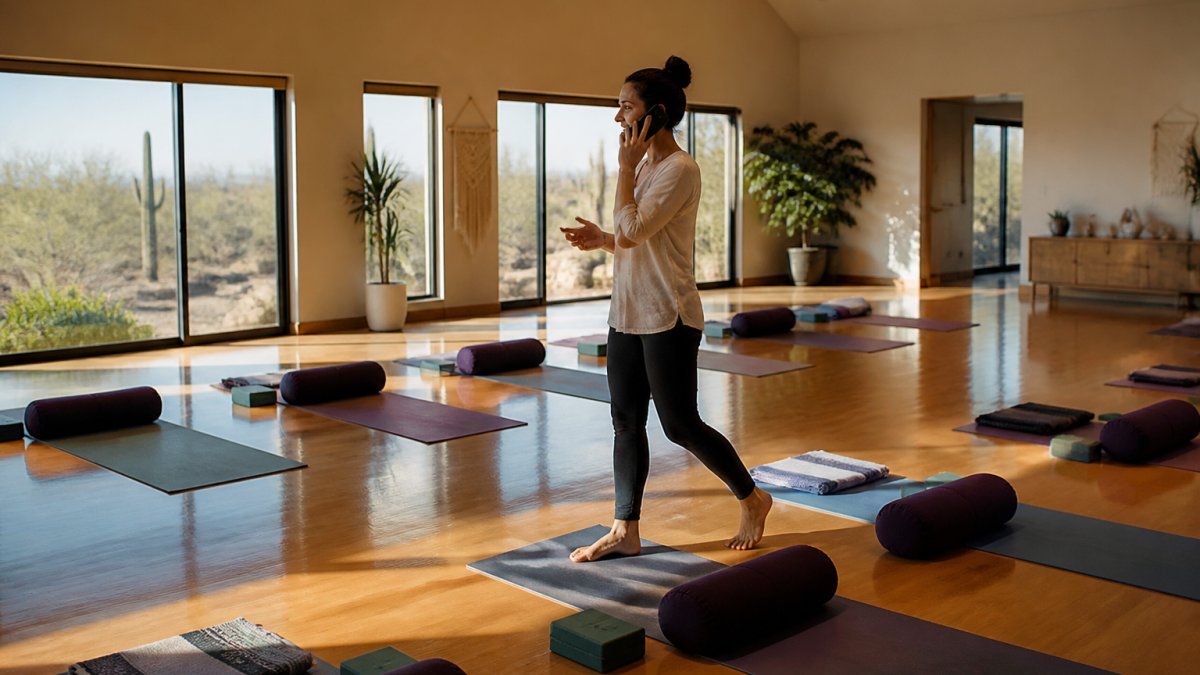
Look for enough square footage that mats do not touch, proper ventilation, natural light, and a sound system that does not distort during guided meditation.
At our sanctuary, the fully equipped yoga studio holds 20 mats, and we keep the space uncluttered so a teacher can set the room however the practice demands.
What to Check Before You Book the Space
- Can the room hold your full group size with comfortable mat spacing?
- Is the floor suitable for kneeling, inversions, and long holds?
- Are props (blocks, straps, bolsters, blankets) included or do you supply them?
2. Accommodations That Support Rest and Recovery
Accommodations are where retreats quietly succeed or fail. A retreat is an emotional and physical intensive, and participants need real sleep to integrate what surfaces during practice.
The right venue offers comfortable beds, private or well-separated sleeping arrangements, and enough bathrooms that no one queues at 6 a.m. before morning sadhana. Rustic luxury is fine, but never thin mattresses or cold shared showers.
Run the Configuration Math Before You Book
Ask for a written bed map, not a bed count. A room that "sleeps four" may mean two queens and a pullout sofa, which changes who shares with whom over five days. Confirm:
- Bed types per room, king, queen, twin, bunk, or convertible. Twin beds are the most flexible for unrelated roommates; a room of queens forces pairing decisions.
- Bath-to-guest ratio, a common planning benchmark is one full bath per three to four guests for a group of 12 or more. Below that, morning sadhana and evening wind-down collide.
- Private vs. shared options, some teachers need at least one or two private rooms for guests with medical needs, seniors, or the facilitator themselves.
Our villa offers 5 bedrooms, 6 baths, and 17 beds across roughly 7,000 square feet, letting a teacher house a group without bunk rooms. The bath count exceeds the bed count, so mornings do not bottleneck, and the layout allows private rooms for guests who need them.
Accessibility and Safety in Sleeping Spaces
Accessibility is the amenity teachers forget until a student with a mobility aid arrives. Confirm ground-floor bedroom access, doorway widths, grab bars in at least one bathroom, step-free paths from parking to the sleeping wing, and night lighting along walkways. Ask how the venue handles emergency contact, overnight support, and the nearest hospital.
What to Confirm in the Accommodation Contract
- Bed map with bed types per room
- Bath count and whether any are shared or en suite
- Ground-floor and accessible room availability
Get the configuration, bath ratio, accessibility, and overnight support right, and your group arrives at practice rested instead of resentful.
3. Meals and Dietary Support That Keep Groups Energized
Meals and dietary support are the amenity teachers underestimate most. A group fed heavy, generic food shows up to afternoon practice sluggish and distracted.
Ask whether the venue provides an on-site chef, whether meals are included in the retreat package, and how it handles dietary needs such as vegetarian, vegan, gluten-free, and allergen restrictions.
We are fortunate here: our team includes an Ayurvedic chef with meal plans, and we build meal plans around each group's dietary needs rather than handing over a fixed menu.
4. Wellness Therapies and Outdoor Activities Beyond the Mat
Wellness therapies and outdoor activities give a retreat its texture. Yoga alone can carry a weekend, but a full week benefits from contrast: sound bath healing, breathwork, massage, Reiki, and time outdoors. The operational question is which therapies are included in the venue rate, which are add-ons, how many guests each can serve per session, and how they fit a schedule without cannibalizing practice time.
Included vs. Add-On: Ask for the Line Item
Before you build a schedule, get a written list that separates what is bundled into the venue rate from what carries an additional fee. Common patterns:
- Included, access to grounds, trails, pool, hot tub, sauna, fire ring, and the practice studio; often a welcome ceremony or one group sound bath.
- Add-on, private massage, Reiki sessions, one-on-one breathwork, cacao ceremony facilitation, and specialty sound journeys. These are usually priced per session or per facilitator hour, and they are the line items that quietly blow a retreat budget.
- Capacity per session, a sound bath may hold your full group of 20; private massage may serve only four to six guests per day. Plan the ratio before you promise therapies in your marketing.
Ask each venue how many guests a given therapy can serve per day, whether the facilitator is in-house or contracted, and whether the teacher or the venue handles booking and payment for add-ons.
Scheduling Therapies Without Breaking the Practice Arc
A pattern that works: mornings for practice and workshops, early afternoon for outdoor activity or pool time, and therapies in late afternoon and evening so they function as integration rather than interruption.
Nature-based activities matter as much as the therapies. Guided walks, trails, a labyrinth, a fire ring, or a pool with a waterfall give participants space to process quietly between sessions.
Safety, Consent, and Group Fit
Any therapy involving touch, breathwork, or altered states needs a consent and screening conversation. Confirm facilitators carry current liability insurance, the venue has a written protocol for guests who become emotionally activated, and a quiet space exists for a guest to step out. For cacao ceremonies and plant-based offerings, ask how contraindications and dietary restrictions are handled, and confirm participation is always opt-in.
Outdoor Amenity Checklist for Teachers
- Trails or walking paths on property, with lighting for evening use
- Pool and hot tub hours, depth, and supervision expectations
- Fire ring or ceremony space with seating for your full group
Therapies and outdoor amenities turn a yoga week into a retreat. Get the included/add-on split, session capacity, scheduling fit, and safety protocols clear before you book, and these amenities become the differentiator your group remembers, not the line item that wrecked your margin.
5. Teacher Logistics and On-Site Support
Teacher logistics and on-site support separate a venue from a true partner.
Ask who is on-site during your retreat, how quickly issues get resolved, and whether the venue helps with setup, check-in, and programming.
Mark and Lana Royce live on-site in the Casita adjacent to the villa during retreats, so hosts and guests have direct access to support around the clock.
Connectivity and Work Facilities
Connectivity is the amenity teachers forget to confirm until they need it. Even a fully unplugged retreat requires reliable Wi-Fi for facilitator communications, emergency contact, and the occasional student checking in at home.
Confirm Wi-Fi coverage in sleeping rooms and the studio, cell reception, and whether there is a quiet space for a teacher to take a call or handle logistics.
Your Yoga Retreat Venue Checklist: What to Confirm Before Booking
A yoga retreat venue checklist turns a pleasant site visit into a real decision. Use this one to compare venues on what actually affects your group.
| Amenity | What to Confirm | Why It Matters |
|---|---|---|
| Practice space | Mat capacity, props, flooring, ventilation | Sets your daily teaching quality |
| Accommodations | Bed configuration, bath count, privacy | Protects sleep and recovery |
| Meals | On-site chef, dietary handling, sample menu | Keeps energy steady all week |
| Therapies and outdoors | Included sessions, trails, pool, sauna | Adds depth beyond asana |
| Logistics | On-site staff, hosting model, setup help | Frees you to teach |
| Connectivity | Wi-Fi coverage, cell signal, quiet work space | Covers real-world needs |
| Booking terms | Deposit, cancellation, group size limits | Prevents costly surprises |
Pricing varies by season, group size, and inclusions, so ask each venue for a written quote. Booking terms deserve the same scrutiny as the amenities.
Yoga Retreat Schedule Examples to Shape Your Program
Yoga retreat schedule examples help you picture how a venue's amenities will actually be used. Two frameworks work well for teacher-led groups.
Weekend reset (3 days):
- Day 1: Arrival, gentle yoga, dinner, restorative evening practice
- Day 2: Morning sadhana, breakfast, workshop block, outdoor activity, sound bath
- Day 3: Morning practice, closing circle, departure
Five-day immersion:
- Daily morning practice and pranayama
- Midday workshop or teacher training module
- Afternoon nature walk, pool, or wellness therapy
Match your schedule to what the venue genuinely offers. A retreat center with strong outdoor amenities rewards breathing room; one built around a great studio rewards longer practice blocks.
If you are ready to host, we would love to show you the property.
Frequently Asked Questions
What amenities should a yoga retreat center have?
A strong retreat center amenities list starts with a dedicated practice space that fits your full group with room to move, comfortable accommodations, and meals that handle dietary needs. Look for on-site wellness therapies like massage, sound healing, or breathwork, plus outdoor spaces for nature walks and quiet reflection. Teacher support matters too: a host who handles logistics, clear booking terms, and reliable connectivity so you can run your program without scrambling.
What should yoga teachers look for when choosing a retreat venue?
Start with the practice space: floor type, mat capacity, natural light, and whether the room is reserved for your group alone. Then confirm accommodations, meal planning, and whether the venue offers add-on sessions like sound baths or cacao ceremonies. Ask how many staff are on-site, what the host handles versus what you handle, and what the cancellation terms are. A yoga retreat venue checklist keeps these questions organized so nothing gets missed before you sign.
How do you plan a retreat as a yoga teacher?
Begin with group size and dates, then match the venue to your program. Build a daily flow using proven yoga retreat schedule examples: morning practice, a midday workshop or free block, and an evening restorative session or ceremony. Confirm meals, dietary needs, and add-on therapies in advance. If you want to know how to host a yoga retreat without burning out, delegate logistics to the venue host and keep your energy for teaching.
What meals are best for a yoga retreat?
Meals should be nourishing, easy to digest, and built around fresh vegetables, whole grains, and plant-based proteins, with enough variety to avoid fatigue over several days. Confirm the venue can handle dietary needs like gluten-free, vegan, and allergies without extra stress. An on-site chef who plans around the practice schedule keeps energy steady. Ask whether meals are included in the retreat package and whether snacks and hydration are available between sessions.
Hosting a retreat asks a lot of a teacher: you are planning programming, managing group dynamics, and holding space, all at once. The venue should carry the rest. Blisstopia Retreats offers a fully equipped yoga studio, on-site caretakers, an Ayurvedic chef, and wellness amenities from sound baths to an infrared sauna, all within a private desert sanctuary built for exactly this work. Get started with Blisstopia Retreats and host the retreat your students will remember.