
 How-to
How to Use a Mudra for Balance: A Beginner's Guide
Last Updated: November 12, 2026
Quick Summary
A mudra for balance is a deliberate hand gesture used in yoga and meditation to steady your energy and calm your mind. Choose one gesture that matches your reason for practicing, such as Vayu Mudra for a racing mind or Prana Mudra when you feel drained, and stay with it for at least a week. Form the gesture with light fingertip contact and breathe slowly through the hold.
- Touch the pads of your fingers, not the nails, and keep the contact light rather than pressing hard.
- Beginners can hold each round for 3-5 minutes, one to two rounds per day, morning or before bed.
- Garuda Mudra hooks the thumbs together and interlaces the fingers, then opens the palms like wings.
- Prana Mudra touches the tips of the thumb, ring finger, and little finger while extending the index and middle fingers.
- Release the gesture immediately if you feel numbness, tingling, or sharp pain in the fingers, hand, or wrist.
Table of Contents
- What a Mudra for Balance Actually Does
- How to Perform a Mudra for Balance: Step by Step
- Matching Your Meaning of Balance to the Right Practice
- Safety, Wrist Modifications, and Realistic Expectations
- Frequently Asked Questions
What a Mudra for Balance Actually Does
A mudra for balance is a deliberate hand gesture used in yoga and meditation to steady your energy and calm your mind. The practice rests on a simple idea: your hands are a switchboard for your nervous system, and small changes in finger position can shift how you feel.
The gesture alone is not magic. It works best as a signal to your body that you are settling down.
How Hand Gestures Relate to Prana and the Five Elements
Yogic tradition describes prana as life force, the energy that moves through the body.
The framework ties each finger to one of the five elements:
- Thumb: fire
- Index finger: air
- Middle finger: space
When you touch fingers together, you blend those qualities. A mudra for balance generally aims to settle excess air or fire and bring earth and water forward.
If you want a specific gesture to explore next, our guide to the Samana Mudra for inner harmony walks through one balance-focused hand position in detail.
How to Perform a Mudra for Balance: Step by Step
A mudra for balance works best as a small, repeatable ritual rather than a one-time experiment.
Step 1: Choose One Gesture and One Meaning of Balance
Before you sit down, decide what you actually want from the practice. Balance is a broad word, and the gesture you pick should match your reason for practicing.
- If your mind is racing, choose a grounding gesture such as Vayu Mudra.
- If you feel drained, choose Prana Mudra.
- If you feel stuck or heavy, choose Garuda Mudra.
Pick one and stay with it for at least a week. Switching gestures every session makes it hard to notice whether anything is changing.
Step 2: Set Up Your Posture
Sit on a cushion, a folded blanket, or a firm chair. The goal is a spine that feels tall without being rigid. Let your shoulders drop away from your ears and soften your jaw.
Rest your hands on your knees or thighs, palms up. If your arms feel heavy, place a small pillow under each forearm so your elbows are supported.
Step 3: Form the Gesture Lightly
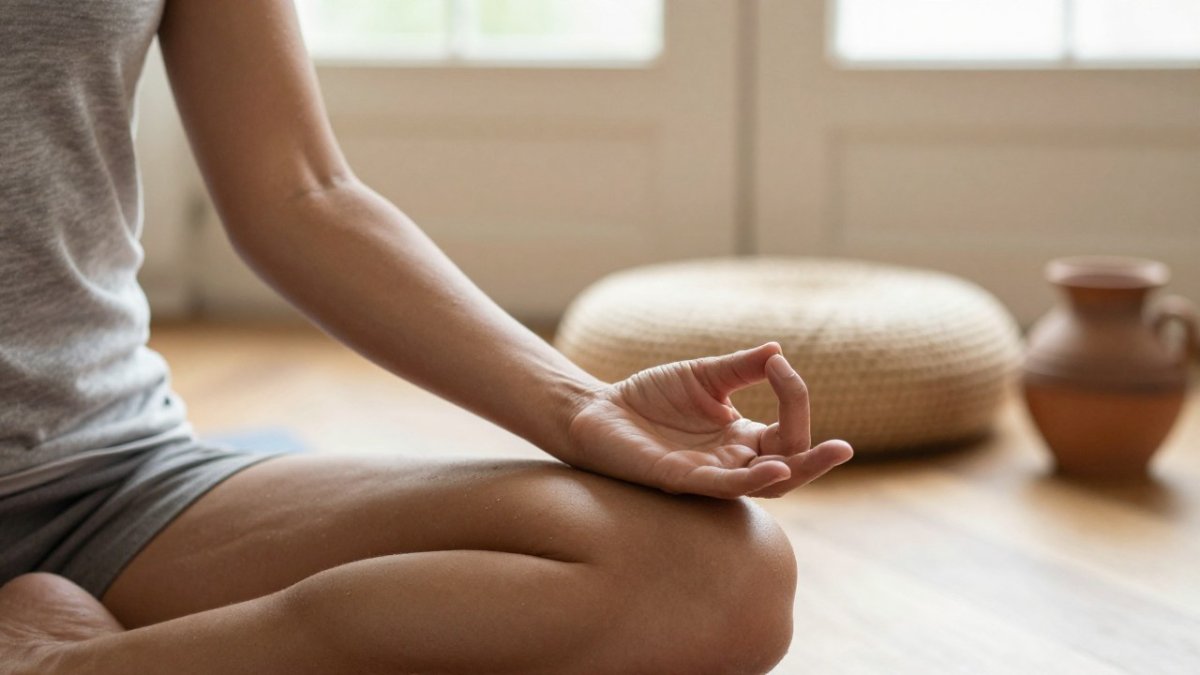
Bring the relevant fingertips together using the lightest contact that still feels deliberate. Touch the pads of the fingers, not the nails. Let the remaining fingers stay relaxed and slightly curved rather than stiff and splayed.
A common mistake is pressing hard. A firm press creates tension in the hands and forearms, which works against the settling effect you are trying to create. Light contact is enough.
Step 4: Breathe Slowly Through the Hold
Close your eyes or soften your gaze downward. Breathe in and out through your nose at a comfortable, slightly slower pace than usual. You do not need a special count, but many practitioners find that lengthening the exhale a little helps the body settle.
Keep your attention on the physical sensation of the fingertips touching and on the movement of your breath. When your mind wanders, return to those two anchors.
Step 5: Release Slowly
When the round is finished, release the gesture slowly rather than dropping your hands. Shake out your hands and wrists gently, roll your shoulders, and take one or two normal breaths before standing. As your hands settle, you can carry that same quiet attention into a daily ritual with crystals through MyLee Moon Blessings.
Troubleshooting Common Problems
- Fingers slip apart. Rest your hands lower on your thighs so gravity helps, and reduce the amount of time you hold.
- Hands or forearms ache. Shorten the hold and support your elbows. If aching continues, stop for the day.
- Mind will not settle. Try a shorter round with a longer exhale, or pair the gesture with a few minutes of slow walking.
- You feel nothing. That is common at first. Consistency over a couple of weeks matters more than any single session.
Watch out: if you feel numbness, tingling, or sharp pain in the fingers, hand, or wrist, release the gesture immediately and rest. Discomfort is a signal to modify, not to push through.
Accessibility and Hand Modifications
Mudras should not require pain to practice. If finger joints are stiff, bring the fingertips as close as comfortable rather than forcing contact.
},{"name":"Rounds Per Day","unit":"","items":[{"label":"Beginner","min":1,"max":2,"display":"1-2"},{"label":"Regular practice","min":2,"max":3,"display":"2-3"},{"label":"Experienced","min":2,"max":3,"display":"2-3"}]}]}" style="margin:2rem 0; padding:20px 20px 10px; border:1px solid #e5e7eb; border-radius:12px; background-color:#ffffff;">Hold Per Round
A common approach is three times a day for a few minutes each. Start with one round and build. If your hands fatigue, stop and rest.
Matching Your Meaning of Balance to the Right Practice
Balance means different things to different people, and the traditions behind mudras describe balance in more than one framework. Here is a plain-language guide to the three frameworks and how to choose a practice that fits what you actually mean by balance.
The Three Frameworks, Briefly
- Elemental framework. Each finger is tied to one of five elements: thumb to fire, index to air, middle to space, ring to earth, little finger to water. A gesture blends those qualities. Balance here means settling an excess of one element and inviting another forward.
- Chakra framework. Gestures are paired with energy centers along the spine, and balance means supporting flow through a particular center. This lens is more about where energy feels blocked than about elemental mix.
- Dosha framework. Rooted in Ayurveda, this lens describes three constitutional tendencies, vata (air and space), pitta (fire and water), and kapha (earth and water). Balance here means pacifying whichever tendency is aggravated.
These frameworks overlap in practice but are not interchangeable. A gesture described as grounding in the elemental system may be described as vata-pacifying in the dosha system. Neither description is wrong; they are different maps of the same territory.
A Simple Chooser
Use your own description of imbalance to pick a starting point.
- Racing mind, restlessness, trouble settling. This reads as excess air in the elemental framework and as vata aggravation in the dosha framework. A grounding gesture such as Vayu Mudra fits both descriptions.
- Irritability, heat, impatience. This reads as excess fire and as pitta aggravation. A cooling, settling gesture with slow exhales is a reasonable starting point.
- Heaviness, lethargy, low motivation. This reads as excess earth and water and as kapha tendency. A lifting gesture such as Garuda Mudra fits the elemental description.
- Drained, scattered, low vitality. This reads as depleted life force. Prana Mudra is the traditional choice.
Matching the Practice, Not Just the Gesture
A hand gesture alone is a small intervention. The surrounding practice does most of the work, so match that too.
- If you want calm, pair the gesture with a longer exhale and a quiet room.
- If you want focus, pair it with an upright posture and a single point of attention, such as the breath at the nostrils.
- If you want energetic steadiness, pair it with a short walk or a few minutes of standing practice after the hold.
- If you want a fuller reset, go deeper than a hand gesture and combine breathwork, meditation, and rest.
If you want a broader approach, our piece on finding balance through yoga, meditation, and Ayurveda connects these practices. And if you want to learn them in person, you can browse our retreats for an immersive setting.
Safety, Wrist Modifications, and Realistic Expectations
Mudras are low-risk, but they are not a treatment for a medical condition.
Keep these safety points in mind:
- Stop if you feel numbness, tingling, or sharp pain.
- Support your wrists on a cushion if they ache.
- Skip long holds if you have wrist or hand injuries.
- Use a modified touch if finger joints are stiff.
Research on mudras is limited, and much of what is written comes from tradition rather than controlled studies.
If energy work interests you, our overview of the energy healing experience explains what to expect.
Balance is not something you find once and keep.
Frequently Asked Questions
What is the mudra for balance?
There is no single mudra for balance. Garuda Mudra is traditionally associated with lift and focus, while Prana Mudra is traditionally linked to vitality and Vayu Mudra to restlessness. The right one depends on what balance means to you, whether that is calm, groundedness, or clarity. Try each for a few minutes at dawn or dusk and notice which one leaves you feeling more centered.
How long should you hold a mudra?
Most teachers suggest holding a mudra for 5 to 15 minutes, once or up to three times a day. Beginners can start with 3 to 5 minutes and build up. A short daily practice at dawn or dusk is a practical starting point. Release slowly and shake out your hands afterward.
Can yoga mudras help you feel calmer and more centered?
Many practitioners report feeling calmer after a few minutes of mudra and meditation practice, though the evidence is largely traditional rather than clinical. Mudras pair well with breathwork and seated meditation. Treat mudras as a low-risk complement to your routine, not a replacement for medical care, and stop if you feel hand or wrist pain.
Which mudra is best while walking?
Prana Mudra is a practical choice while walking because it is simple to hold with the thumb, ring, and little fingers while the index and middle fingers stay extended. Keep your hands relaxed at your sides or lightly at the belly, and let your breath set the pace. If you prefer a more active gesture, Garuda Mudra can be held briefly during a slow, mindful walk.