 listicle
Intentional Solitude: Natural Beauty vs. Bliss & Rejuvenation
Table of Contents
- Why Natural Beauty Amplifies Intentional Solitude
- The Benefits of Intentional Solitude for Lasting Rejuvenation
- How to Practice Solitude for Healing: A Step-by-Step Approach
- Spiritual Desert Retreats: Where Nature and Inner Peace Meet
- The Science of Bliss: What Happens to Your Body in Solitude
- Solitude Rituals for Urban Dwellers: Finding Quiet in a Noisy World
- Conclusion: Choosing Your Path to Rejuvenation
- Frequently Asked Questions
Last Updated: September 14, 2026
Why Natural Beauty Amplifies Intentional Solitude
Intentional solitude is the deliberate choice to spend time alone for reflection, restoration, and self-discovery rather than as a response to isolation. It differs from loneliness because you choose it, structure it, and leave it feeling fuller rather than emptier. This guide from Blisstopia Retreats examines how natural settings, particularly desert landscapes, deepen that practice.
The setting matters more than most people expect. A quiet room helps. A quiet canyon rewires something deeper.
American Psychological Association resources on solitude and well-being notes that time alone, when freely chosen, supports emotional regulation and mental clarity. The environment you choose for that time shapes how far the benefits reach.
How Desert Landscapes Quiet the Cognitive Mind
Desert terrain strips away the sensory noise that cities generate constantly. No traffic hum, no screens, no crowds competing for attention. What remains is scale, silence, and slow change.
That reduction in cognitive demands gives your inner voice room to surface. Many people who practice solitude in wild settings describe the first hour as uncomfortable, then something shifts. The mind stops reaching for distraction and starts settling.
The Benefits of Intentional Solitude for Lasting Rejuvenation
Rejuvenation from solitude goes beyond feeling rested. The research literature on freely chosen alone time points to a cluster of measurable shifts: sharper self-awareness, reduced stress reactivity, improved emotional regulation, and clearer decisions about work and relationships. The key word is intentional, solitude you plan for delivers what isolation never can.
What Actually Changes, and Why
Four mechanisms do most of the work:
- Cognitive decompression. Uninterrupted time removes the task-switching tax that fragmented attention imposes all day. Most people find that after 30 to 45 minutes without input, thinking becomes linear again, one thought finishes before the next begins.
- Emotional processing. Without an audience or a feed to perform for, unprocessed feelings surface and complete. This is why grief, anger, and old decisions often arrive uninvited in the first hour of quiet.
- Perspective recalibration. Distance from daily roles lets you see patterns, the meeting you keep dreading, the relationship you keep managing, that proximity hides.
- Restored agency. Choosing how to spend an hour, with no one to negotiate with, rebuilds the sense that your time belongs to you. That sense is one of the strongest predictors of whether alone time feels restorative or corrosive.
Loneliness vs. Solitude: Understanding the Difference
Loneliness is a deficit. Solitude is a practice.
Loneliness arrives uninvited and drains energy. Intentional solitude is scheduled, bounded, and purposeful, which is why it supports psychological well-being instead of eroding it. A common mistake is treating any alone time as automatically restorative. It isn't. Scrolling alone on a couch is isolation with a screen. Walking a trail alone with a question you want answered is solitude.
| Dimension | Loneliness | Intentional Solitude |
|---|---|---|
| Origin | Imposed by circumstance | Chosen deliberately |
| Duration | Open-ended, draining | Bounded, restorative |
| Focus | Absence of others | Presence of self |
| Outcome | Depletion, anxiety | Mental clarity, renewal |
The Rejuvenation Timeline
Most practitioners describe a predictable arc, and knowing it in advance is what keeps people from quitting at the hard part:
- First 20 minutes: restlessness, phone cravings, the sense that you should be doing something.
- 20 to 60 minutes: the nervous system downshifts. Breathing slows, shoulders drop, boredom turns into something closer to calm.
- One to three hours: reflection deepens. Questions you arrived with start producing answers, or better questions.
- A full day or more: the effects consolidate. Sleep improves, reactivity drops, and decisions that felt stuck begin to move.
The mistake almost everyone makes is judging the practice by the first 20 minutes. That window is withdrawal, not the destination.
Why This Matters More as You Get Older
People who have spent decades pouring into careers, children, and aging parents often lose track of their own preferences entirely. Solitude is how those preferences get recovered, not through insight alone, but through repeated, bounded exposure to your own unfiltered thinking. That is the difference between a restful weekend and a genuine reset.
How to Practice Solitude for Healing: A Step-by-Step Approach
Learning how to practice solitude for healing follows a predictable arc. Most people fail because they attempt too much, too fast, in the wrong environment, or because they have no plan for what to do when the quiet turns uncomfortable.
- Set a bounded window. Start with 90 minutes, not a weekend. A defined end time is what makes the experience feel chosen rather than imposed.
- Remove the digital layer. Leave the phone behind or in airplane mode. This is the single highest-leverage step, and the one most people skip.
- Choose a natural setting. A trail, a garden, a quiet shoreline. Water and elevation change tend to work faster than flat, familiar ground.
- Bring one question. Vague time alone drifts; a question gives it direction. Good ones are specific: What am I avoiding? What would I do if no one were watching? What am I still carrying that isn't mine?
- Sit with discomfort first. Boredom is the doorway, not the obstacle.
- Close with writing. Ten minutes of reflection locks in what surfaced. Without it, the insight fades within a day.
Expected result: after three or four sessions, most people notice lower reactivity and clearer thinking within a day of practice.
The Digital Detox Is Not Optional
This is the gap most solitude advice skips. The depth of your connection to a natural setting is inversely proportional to how reachable you remain. A phone in your pocket keeps the mind in partial-alert mode, monitoring, anticipating, half-listening for a buzz, and the nervous system never reaches the restorative state that solitude is meant to produce. Removing digital stimuli is not a nice-to-have layer on top of nature time. It is the mechanism that lets nature time work at all.
A practical progression: leave the phone in the car for a 90-minute walk. Then a half-day. Then a full day. Each step teaches your nervous system that unreachability is survivable.
A Repeatable Structure: The Four-Part Session
One-off outings produce one-off relief. A structure produces cumulative change. Most practitioners who stick with the practice use some version of this:
- Arrive (10 minutes). Walk slowly. No agenda. Let the setting register.
- Settle (20 minutes). Sit. Breathe. Let the restlessness burn off.
- Engage (40 minutes). Walk or sit with your question. Follow the thread wherever it goes.
- Close (10 minutes). Write three sentences: what surfaced, what it means, what you will do differently.
The proportions matter less than the sequence. Arriving before engaging is what separates a reflective hour from a restless one.
When It Goes Wrong
Three failure modes account for most abandoned attempts:
- You scheduled too long. A first attempt at a full silent day almost always collapses into rumination. Start at 90 minutes and extend only after the shorter window feels easy.
- You brought a problem instead of a question. Problems demand solutions and generate anxiety. Questions invite exploration and generate insight.
- You treated it as a performance. Solitude is not a productivity practice. If you spend the hour auditing whether it is working, it isn't.
Building the Habit
Consistency beats intensity. A 90-minute session every week for two months will change more than a single silent weekend. Put it on the calendar with the same weight as any other commitment, protect it from being rescheduled, and let the accumulated hours, not any single breakthrough, do the work.
Spiritual Desert Retreats: Where Nature and Inner Peace Meet
Spiritual desert retreats combine intentional solitude with structured practice: breathwork, meditation, sound healing, and ceremony held in wild settings. The desert's scale does part of the work. Facilitators and community do the rest.
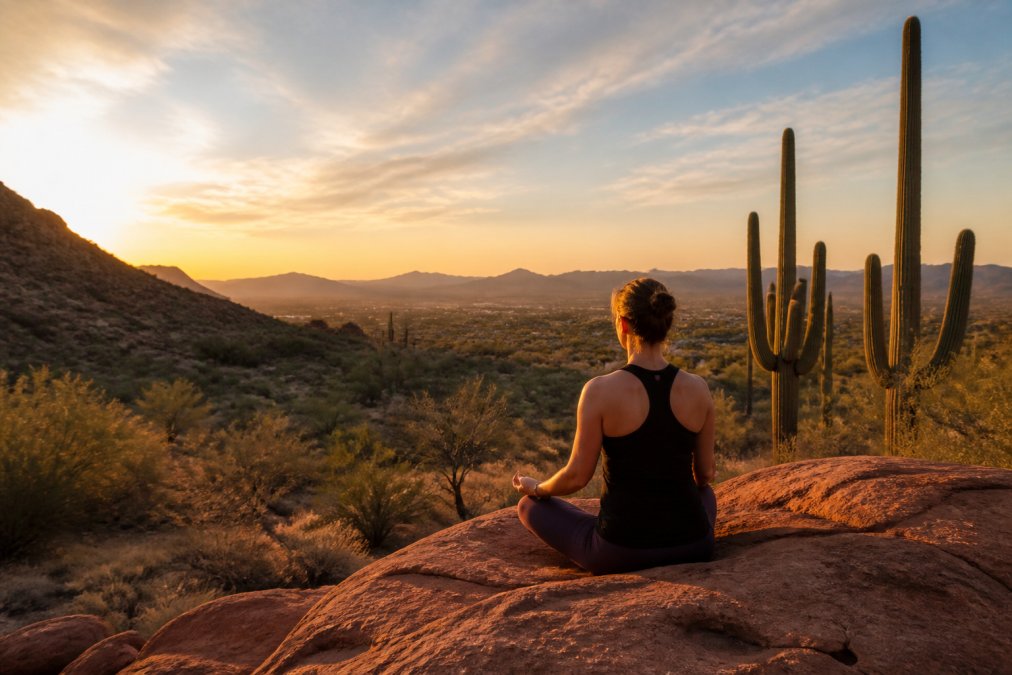
Blisstopia Retreats operates a faith-based sanctuary on secluded acreage at the base of Sunrise Mountain near Peoria, Arizona, where retreats blend guided breathwork, sound bath healing, meditation, cacao ceremony, cold plunge, and organic meals. Mark and Lana Royce live on-site and hold space personally, which matters when solitude work turns up something heavy.
The Science of Bliss: What Happens to Your Body in Solitude
Quiet, nature-based solitude shifts the body toward parasympathetic activity, the rest-and-recover branch of the nervous system. Heart rate settles. Breathing deepens. Stress hormones ease. Researchers studying nature immersion describe measurable drops in rumination and improvements in attention after time in natural environments, and the National Park Service health and wellness research documents similar patterns for visitors in protected landscapes.
The physiological markers of rejuvenation are unglamorous but real: slower pulse, deeper sleep, steadier mood, restored focus. You cannot fake them with a spa day.
Solitude Rituals for Urban Dwellers: Finding Quiet in a Noisy World
You do not need a desert to practice. You need a boundary.
- The 6 a.m. window. One hour before the household wakes, phone off, one cup of tea, no input.
- The walking commute. One stop early, no podcast, no call.
- The Sunday reset. Ninety minutes in a park with a notebook and one question.
- The quarterly day. One full day alone, scheduled like any other commitment.
Treat each as non-negotiable. Solitude that waits for spare time never happens.
Conclusion: Choosing Your Path to Rejuvenation
The hard part is not finding quiet. It is protecting it against a calendar that fills itself.
If you want more than a weekend of rest, if you want the deeper version of this work held by people who have guided it for decades, Blisstopia Retreats offers transformational retreats built around intentional solitude, guided breathwork, sound bath healing, and the stillness of the Sonoran Desert. Mark and Lana live on-site, so support is never more than a short walk away. Call 623-986-2899 to ask about upcoming retreat dates and what a stay includes. Embracing this quiet rhythm requires a fundamental shift in how we occupy our time, which is why cultivating a guide to intentional living remains the most effective way to sustain the peace found during these desert retreats.
Frequently Asked Questions
What does intentional solitude mean for mental health?
Intentional solitude means deliberately choosing time alone to reflect, recharge, and reconnect with yourself. Unlike isolation, which can feel lonely and forced, intentional solitude is a restorative practice. It reduces stress, improves mental clarity, and supports emotional healing. Research shows that quiet time activates the parasympathetic nervous system, helping your body recover from chronic stress and cognitive overload. Practicing intentional solitude regularly can boost self-awareness and psychological well-being.
How does nature-based solitude differ from simple isolation?
Nature-based solitude combines being alone with immersion in natural environments, which amplifies the benefits. While simple isolation may feel empty or depressing, nature immersion provides sensory grounding and a sense of connection to something larger. Studies indicate that time in nature lowers cortisol, improves mood, and enhances cognitive restoration. The natural world offers gentle stimulation that supports introspection without the draining effects of urban noise or digital distractions.
What are the benefits of a spiritual retreat for finding inner peace?
A spiritual desert retreat offers a structured, supportive environment for deep introspection and healing. Removing daily distractions allows you to focus on personal reflection and mindfulness. The combination of natural beauty, guided practices like breathwork and meditation, and a community of like-minded individuals can accelerate self-discovery and emotional release. Many find that the peace they cultivate on retreat stays with them long after they return home.
How can one cultivate a state of bliss in a busy world?
Cultivating bliss starts with small, consistent moments of intentional solitude. Try waking 15 minutes earlier for quiet reflection, taking a nature walk without your phone, or creating a calming corner in your home. Deep breathing and mindfulness exercises can also shift your nervous system into a restorative state. Over time, these micro-practices build resilience, making it easier to access inner peace even amid daily demands.