 how-to
How to Find Spiritual Renewal Retreats: 2026 Guide
Table of Contents
- What Spiritual Renewal Retreats Actually Offer
- The Real Benefits of Stepping Away
- Retreat Settings: Monasteries, Deserts, and Wellness Centers
- What a Faith-Based Wellness Ministry Looks Like
- Why Desert Spiritual Healing Retreats Work
- Choosing a Retreat for Emotional Restoration
- Preparing Mentally and Physically Before You Go
- Making It Last: Integration After You Return
- Frequently Asked Questions
Last Updated: September 10, 2026
What Spiritual Renewal Retreats Actually Offer
Learning how to find spiritual renewal retreats starts with understanding what they are: structured, intentional getaways designed to restore your inner life through silence, prayer, meditation, and community. At Blisstopia Retreats, we describe them as a pause with a purpose, not a vacation with a yoga class bolted on.
The distinction matters. A spa weekend treats the body. A spiritual renewal retreat works on the whole person: spiritual formation, emotional honesty, and the quiet that lets you hear yourself think again. Many retreat centers follow a rhythm that includes contemplative prayer, guided reflection, and long stretches of silence.
Harvard Health Publishing on meditation and the relaxation response notes that regular contemplative practice can calm the body's stress response, which is part of why retreats feel different from ordinary time off.
Most retreats share a common structure:
- Arrival and settling in, often with a shared meal
- Daily meditation, breathwork, or contemplative prayer
- Guided reflection or spiritual direction sessions
- Free time for solitude, journaling, or walking
- Closing ceremony or circle before departure
The Real Benefits of Stepping Away
The clearest benefit of a retreat is restoration, and it rarely comes from a single activity. It comes from removing distraction long enough for your nervous system to settle. Guests often arrive exhausted and leave describing something closer to inner peace than simple rest.
A common mistake is treating a retreat as a cure-all. It is not therapy, and it is not a replacement for medical care. What it does well is create the conditions for healing: silence, sacred space, and unhurried time.
- Clarity about what you actually want next
- Relief from decision fatigue and constant input
- Renewed spiritual health through practice, not performance
- A felt sense of rejuvenation that outlasts the drive home
Retreat Settings: Monasteries, Deserts, and Wellness Centers
The setting shapes the experience as much as the programming does. Three broad options dominate, and each suits a different temperament, budget structure, and tolerance for structure. The fastest way to narrow the field is to decide which of these three you are actually looking for before you start comparing individual retreats.
A monastery or abbey offers hospitality, structured prayer, and simplicity. You eat what is served, keep the hours of the community, and let the schedule carry you. Many monasteries and retreat houses run on a donation or suggested-offering model rather than fixed commercial pricing, which makes them the most affordable guided option for many people. Best for anyone who wants tradition, silence, and zero decisions. The trade-off is real: limited flexibility, shared quarters in some houses, and a rhythm set by the bell rather than by you.
A desert or nature-based center leans on landscape. Wide horizons and quiet do a lot of the work, and solitude comes easily. Best for anyone who thinks better outdoors or who has never been able to settle in a classroom-style setting. The trade-off is fewer amenities and more personal responsibility, you are often managing your own hydration, heat exposure, and downtime, and cell service may be unreliable by design.
A wellness center blends programming with comfort: yoga studios, sound healing, breathwork, and often a pool or sauna. Best for people who want structure and rest in the same week, or who are new to retreats and want a softer landing. The trade-off is that a full daily schedule can quietly become another form of busyness if you do not protect empty time.
| Setting | Best For | Typical Structure | Cost Pattern | Watch Out For |
|---|---|---|---|---|
| Monastery or abbey | Tradition, silence, simplicity | Fixed prayer and meal schedule | Often donation or suggested offering | Limited flexibility, shared quarters |
| Desert or nature center | Solitude, reflection, wide space | Open days with some guidance | Varies widely; often all-inclusive | Heat, isolation, fewer amenities |
| Wellness center | Comfort plus programming | Full daily schedule | Highest of the three; add-ons common | Schedule can crowd out rest |
A fourth path sits outside all three: the DIY retreat. You pick a quiet rental near nature, set a simple daily rhythm of meditation, walking, and journaling, and keep your phone off. It is not the same as guided facilitation, and it will not give you the accountability or the group container. But it is the lowest-cost option by a wide margin and it beats waiting for the perfect moment or the perfect budget.
Whichever setting you choose, ask two questions before booking: what does a typical day actually look like hour by hour, and how much unstructured time is built in? A retreat with no empty space is a conference. A retreat with nothing but empty space is a rental house. The right setting gives you both structure and room to disappear into your own thoughts.
What a Faith-Based Wellness Ministry Looks Like
A faith-based wellness ministry is a retreat provider that treats spiritual practice as the foundation rather than an add-on, usually operating as a religious or nonprofit entity rather than a commercial resort. Blisstopia Retreats is one example: a private membership association in the Sonoran Desert near Peoria, Arizona, founded by Mark and Lana Royce.
That structure changes the feel of a stay. Mark and Lana live on-site during retreats, so support is present around the clock rather than scheduled. Guests are not pushed toward a single denomination or a rigid doctrine. They are invited to come as they are, with no experience required.
The offerings blend ancient and modern practice: guided breathwork, sound bath healing, meditation, Reiki, cacao ceremony, cold plunge, and Ayurvedic meal planning. Lana brings 25+ years as a psychotherapist; Mark brings decades of martial arts and breathwork coaching.
Why Desert Spiritual Healing Retreats Work
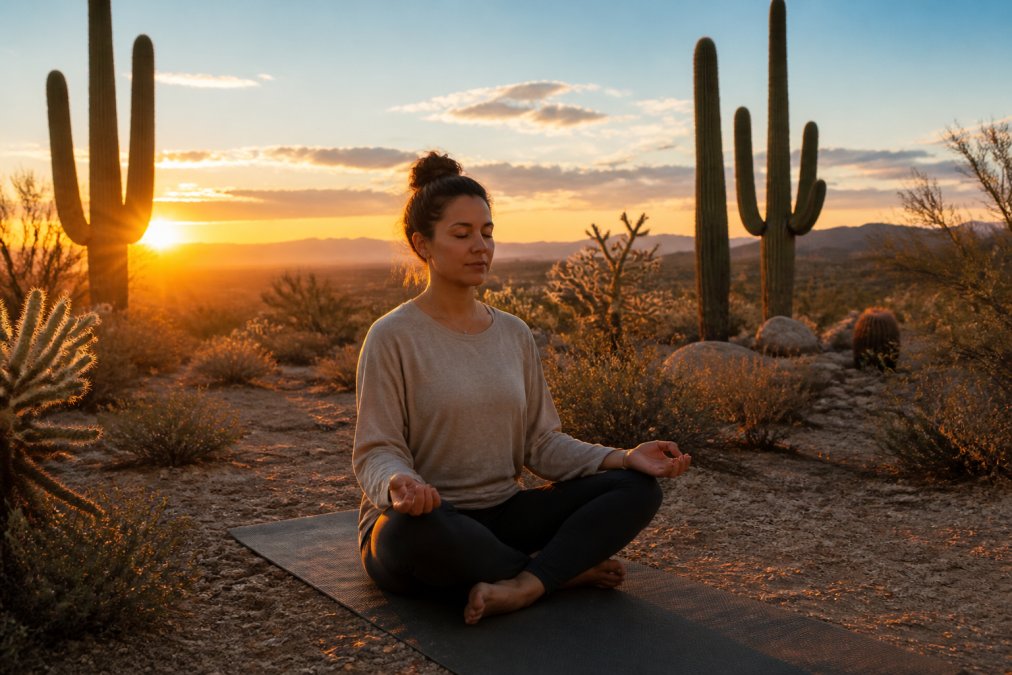
Desert spiritual healing retreats work because the environment strips away stimulation. No traffic noise, no screens competing for attention, no crowds to manage. What remains is heat, sky, and time. For many people, that is the first honest quiet they have had in years. finding spiritual peace.
Our sanctuary sits on 2.5 secluded acres at the base of Sunrise Mountain, with hiking trails, a natural labyrinth, and a fire ring. Guests frequently describe the landscape itself as a facilitator.
National Park Service guidance on desert safety and heat is worth reading before any desert stay, since hydration and timing matter more than most first-timers expect.
Choosing a Retreat for Emotional Restoration
Choosing a retreat for emotional restoration comes down to fit, not prestige. The right program matches your intent, your budget, and the depth you can actually handle this season.
Work through these questions before you book:
- What am I actually seeking: rest, grief work, direction, or connection?
- How many days can I genuinely step away? Three is workable; five is generous.
- Do I want solitude, community, or a mix?
- Is the setting religious, secular, or open to both?
- Who leads the sessions, and what are their credentials?
- What is included, and what costs extra?
- Can I speak to someone before committing?
On cost, pricing depends on length, accommodations, and inclusions, so ask directly for a full breakdown rather than comparing headline numbers. A retreat that includes meals, lodging, and facilitation is not the same purchase as a room with add-ons.
If you are planning a smaller budget, a DIY approach works: pick a quiet rental near nature, set a simple daily rhythm of meditation and walking, and keep your phone off. It is not the same as guided facilitation, but it beats waiting for the perfect moment.
Preparing Mentally and Physically Before You Go
Preparation is where most people lose momentum, and it is the gap most guides skip entirely. Nearly every article tells you where to go. Almost none tell you how to get your mind ready to actually arrive, which is why so many people spend the first two days of a retreat just decompressing from the life they left behind.
The single highest-leverage thing you can do is start disconnecting before you leave. Most people try to go from a full inbox to total silence in one step, and the nervous system does not cooperate. A common pattern that works is a three-to-five-day wind-down:
- Days 5 to 3 out: Tell work and family your offline window and who to contact in a real emergency. Turn off non-essential notifications. Stop checking news and social media first thing in the morning.
- Days 2 to 1 out: Clear your calendar of anything that can wait. Finish the loose ends that would otherwise follow you. Pack your bag early so the last night is calm.
- The night before: Write down what you are bringing to the retreat, one intention, one question, one thing you are ready to put down. Naming it turns a vague hope into something a facilitator can actually work with.
That written intention matters more than it sounds. Facilitators consistently report that guests who arrive with a named intention get further in three days than guests who arrive open-ended get in five. You are not committing to an outcome. You are giving the work a direction.
Physically, sleep matters more than packing. Arrive rested if you can, hydrate in the days before, and go easy on alcohol the week prior, it disrupts the sleep architecture you are about to rely on. If your retreat includes breathwork, cold plunge, long meditation sits, or desert hiking, ask what physical demands to expect and whether any practice has contraindications. Breathwork in particular is not appropriate for everyone, and a responsible host will screen for that.
- Notify work and family of your offline window, and name a backup contact
- Bring a journal and a pen, not just a phone
- Pack layers; desert mornings and evenings run cool even in warm months
- Confirm dietary needs with the host in advance
- Ask what a typical day looks like hour by hour, and how much unstructured time is built in
- Leave the itinerary loose enough to be present
One more thing worth deciding in advance: what you are leaving behind. The people who get the most from a retreat choose one habit, worry, or story they are not carrying back. Write it down before you go. It gives you something concrete to work with on the last day, when the clarity is sharpest.
Making It Last: Integration After You Return
Post-retreat integration is the difference between a good week and a changed year. Without a plan, the clarity fades within days and old patterns move back in.
Book a light first day back. Do not schedule a full calendar the morning you return. Then protect three practices from your retreat and keep them small enough to survive a busy Tuesday: a ten-minute meditation, a weekly walk without your phone, one honest conversation.
Many people find that a follow-up session with a spiritual director, therapist, or coach helps translate insight into habit. Substance Abuse and Mental Health Services Administration on wellness and recovery supports points to ongoing support and community as key to lasting change, and the same principle applies here.
If you want structure and company for that next step, Blisstopia Retreats hosts ongoing classes and seasonal retreats, and our team is glad to talk through what fits. Call 623-986-2899 to ask about current offerings, availability, and what a stay includes.
Frequently Asked Questions
How much does a spiritual renewal retreat cost?
Costs vary widely based on length, location, accommodations, and whether meals and activities are included. Some day programs are affordable, while multi-day all-inclusive stays cost more. Many centers, including faith-based wellness ministries, bundle lodging, organic meals, and guided sessions into one rate. Because pricing depends on dates and programming, request a current quote directly from any retreat you are considering rather than relying on outdated listings.
How do I choose a spiritual retreat that aligns with my needs?
Start by clarifying your goal: emotional restoration, spiritual formation, solitude, or physical rejuvenation. Then match that goal to the retreat's format, group size, and philosophy. Check whether the environment is silent or interactive, religious or open to all beliefs, and whether facilitators have relevant credentials. Read testimonials from past guests, ask about daily itineraries, and confirm the refund and cancellation policy before you commit.
What is the difference between a wellness retreat and a spiritual renewal retreat?
A wellness retreat typically focuses on physical health: fitness, nutrition, spa treatments, and relaxation. A spiritual renewal retreat adds an inner dimension, such as contemplative prayer, guided reflection, meditation, or ceremony, aimed at spiritual growth and reconnection with your sense of purpose. Many retreats blend both, offering yoga, breathwork, and sound healing alongside quiet time for self-reflection and faith formation.
How do I prepare mentally and physically for a spiritual renewal retreat?
In the week before you leave, reduce caffeine and alcohol, prioritize sleep, and set a clear intention for what you hope to release or discover. Mentally, write down the questions you want to sit with and practice short periods of silence or meditation to get comfortable with stillness. Pack comfortable clothing, a journal, and any medications. Tell someone your travel plans and confirm arrival details with the retreat center in advance.
Sustaining renewal after the retreat ends is the hard part, and doing it alone is harder. Blisstopia Retreats offers a faith-based sanctuary where the work continues: on-site caretakers who stay present through the week, guided breathwork and sound healing, and a rhythm built around rest rather than performance. Get started with Blisstopia Retreats and give your next season a foundation that holds.