 listicle
Alternatives to Traditional Yoga Teacher Training in 2026
Table of Contents
- Why Yogis Are Choosing Alternatives to Traditional Yoga Teacher Training
- Online, Hybrid, and Immersive: The Main Alternatives Compared
- Yoga Teacher Training Duration: What Each Format Really Costs You in Time
- The Benefits of Immersive Yoga Retreats for Teacher Development
- Advanced Yoga Teacher Training for Certified Instructors
- How to Become a Yoga Instructor for Beginners: A Non-Traditional Path
- Accreditation, Insurance, and Legal Requirements to Check First
- Choosing the Right Program: A Practical Decision Framework
- Frequently Asked Questions
Last Updated: September 13, 2026
Why Yogis Are Choosing Alternatives to Traditional Yoga Teacher Training
The yoga teacher training landscape has shifted. Where a 200-hour certification once meant four weeks in a single studio, today's aspiring instructors can choose from online, hybrid, and immersive formats that fit around jobs, families, and real life. This guide from Blisstopia Retreats breaks down the alternatives to traditional yoga teacher training programs so you can pick the path that actually matches your goals.
The core tension is simple: traditional programs offer structure and hands-on adjustment, but they demand you disappear for a month. Alternatives trade some of that immersion for flexibility, or they trade flexibility for depth. Neither is automatically better.
Below, we'll show you exactly how each format works, what it costs you in time and money, and which one fits your situation.
Online, Hybrid, and Immersive: The Main Alternatives Compared
The three main alternatives to traditional studio training are online self-paced programs, hybrid immersion models, and full retreat-based immersions (yogaalliance.org). Each delivers the same 200-hour foundational training hours required for Yoga Alliance registration standards, but the learning experience differs sharply.
| Format | Time Commitment | Hands-On Adjustment | Best For |
|---|---|---|---|
| Online/self-paced | 3-12 months, flexible | Limited | Busy schedules, budget focus |
| Hybrid immersion | 2-6 months | Moderate | Balance of flexibility and depth |
| Full retreat immersion | 3-4 weeks intensive | Extensive | Deep transformation, career pivot |
Online and Self-Paced Programs
Online programs deliver the full 200-hour curriculum through asynchronous modules, live-streamed sessions, and recorded lectures. You get lifetime access, anatomy and philosophy modules, and community forums. The trade-off: you lose the physical, hands-on adjustments that only in-person training provides. For students who need flexibility without travel, this remains the most accessible route.
Hybrid Immersion Models
Hybrid models split training between home study and an intensive retreat. You complete coursework online, then travel for a week or two of in-person immersion. This format suits practitioners who want spiritual depth and personal transformation alongside technical skill. The curriculum may lean less on clinical anatomy than a traditional program, so check the module breakdown before committing.
Yoga Teacher Training Duration: What Each Format Really Costs You in Time
Yoga teacher training duration ranges from a few intensive weeks to a full year of part-time study, depending on the format you choose. The 200-hour standard is fixed; how you spread those hours is not.
- Full-time immersion: 3-4 weeks, roughly 8 hours per day
- Part-time hybrid: 3-6 months of weekends plus online modules
- Self-paced online: 6-12 months at your own rhythm
- Advanced 300-hour training: typically 6-12 months beyond your 200-hour base
The real cost isn't just calendar time. It's the income you forgo, the childcare you arrange, and the recovery you need after an intensive. A common mistake is choosing the shortest program and burning out halfway through.
The Benefits of Immersive Yoga Retreats for Teacher Development
Immersive retreats compress years of personal growth into a focused window. When you remove daily distractions and practice in a dedicated sanctuary, skill acquisition accelerates because your nervous system finally settles.
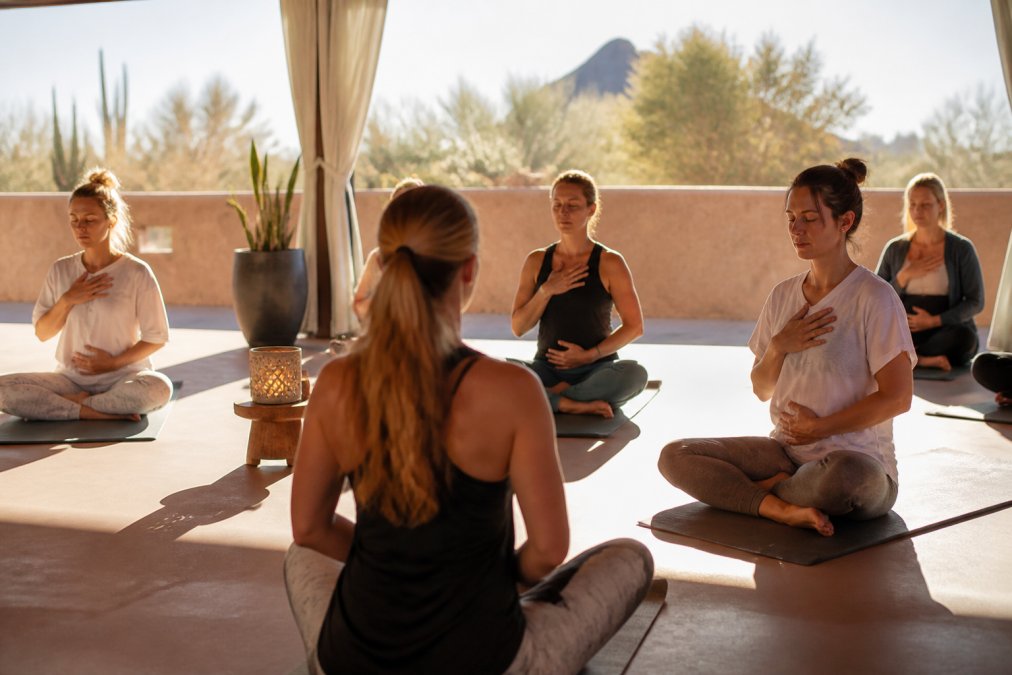
The benefits of immersive yoga retreats extend past the mat. Teaching confidence builds faster when you practice-teach in front of the same small cohort every day. Student-to-teacher ratios stay low, so feedback is constant. Breathwork, meditation, and sound healing become part of the daily rhythm rather than occasional add-ons.
At Blisstopia Retreats, our Peoria sanctuary hosts 200-hour and 300-hour trainings built around exactly this model. Lana Royce, a 500-RYT and teacher of teachers, leads programs that blend Kundalini-inspired practice with trauma-informed sequencing, among other modalities.
Advanced Yoga Teacher Training for Certified Instructors
Advanced yoga teacher training for certified instructors usually means a 300-hour program that deepens your specialty. Once you hold a 200-hour credential, the 300-hour path is where you separate yourself from the crowd of newly certified teachers.
These programs go beyond asana. Expect chakra work, subtle body awareness, embodied leadership, and practice-teaching labs. Many blend in-person immersion with virtual pre- and post-training integration so you can keep teaching while you study.
Niche Certifications That Set You Apart
Generalist certifications are everywhere. Niche credentials are what get you hired. Consider these directions:
- Yin and restorative yoga for therapeutic and senior populations
- Trauma-informed training for studios serving vulnerable communities
- Kundalini and energetic embodiment for teachers moving into transformational facilitation
- Energy healing certification to complement your teaching practice
A niche credential answers a specific client need. That specificity is what makes studios and private clients seek you out.
How to Become a Yoga Instructor for Beginners: A Non-Traditional Path
How to become a yoga instructor for beginners without quitting your job is entirely possible. The non-traditional path follows a clear sequence:
- Build a consistent personal practice for at least six months
- Choose a 200-hour program in a format that fits your schedule
- Complete your practicum and practice-teaching hours
- Register with a credentialing body for industry recognition
- Secure professional liability insurance before you teach
- Start with small classes and seek mentorship
The step most beginners skip is number six. Post-certification mentorship is where real teaching skill forms, and it's the gap most training programs never address.
Accreditation, Insurance, and Legal Requirements to Check First
Accreditation and insurance are the two checks that protect your investment, and the two most guides gloss over. Before you pay tuition, confirm the school holds Registered Yoga School (RYS) status and that your certificate will be recognized by employers, studios, and continuing-education reviewers.
How Yoga Credentialing Actually Works
The dominant credentialing body in the United States is Yoga Alliance, which maintains a voluntary registry rather than a government license. Its structure matters when you compare programs:
- RYS 200 / RYS 300 / RYS 500, the school-level designations. A Registered Yoga School must meet Yoga Alliance's curriculum standards (a minimum of 200 hours covering techniques, anatomy and physiology, yoga humanities, and professional essentials) to register its graduates.
- RYT 200 / RYT 500, the teacher-level designations you earn after graduating from a registered school and paying the registration fee.
- Continuing Education (CE) hours, most registrations require ongoing CE to renew, typically on a multi-year cycle. Ask whether a program's hours qualify for CE credit, because that determines whether your certificate keeps its value.
A critical nuance: Yoga Alliance registration is voluntary and not a legal license. No state requires it to teach. What it does is signal to studios, insurers, and clients that you met a recognized baseline. Some niche programs, trauma-informed, prenatal, restorative, carry their own separate certifications that stack on top of a 200-hour base.
Insurance: The Step New Teachers Skip
Professional liability insurance is the single most common gap for independent teachers. Most studio employment and nearly all private-client work expect you to carry your own coverage. A standard policy typically includes:
- Professional liability, covers claims of injury or negligence during a class
- General liability, covers bodily injury or property damage at a venue
- Optional add-ons, coverage for workshops, retreats, or off-site events
Specialty insurers serving yoga and wellness professionals offer annual policies, and many credentialing bodies offer a member discount. The key questions: Does the policy cover the formats you actually teach (hot yoga, aerial, retreats)? Does it cover you as an independent contractor, not just as a studio employee? Secure coverage before your first paid class, not after.
Business and Legal Setup for Independent Teachers
If you plan to teach independently rather than as a studio employee, a few administrative steps protect you:
- Business registration, many teachers operate as a sole proprietor, but forming an LLC separates personal assets from business liability. Check your state's requirements.
- Tax treatment, independent teaching income is typically self-employment income, which carries its own filing and estimated-payment obligations.
- Waivers and releases, a signed liability waiver is standard practice, though it does not replace insurance.
- Venue agreements, if you rent space, confirm who carries liability coverage for the location.
Technical Requirements for Online and Hybrid Training
If you are comparing online or hybrid programs, verify the technical bar before enrolling:
- Hardware, a reliable computer or tablet with a working webcam and microphone
- Connection, stable high-speed internet, ideally with a backup hotspot for live sessions
- Space, a quiet, well-lit area for practice-teaching and video submission
- Platform, confirm whether sessions run on Zoom, a proprietary LMS, or recorded modules, and whether recordings are available if you miss a live session
Test your full setup before the first module, not during it. A dropped connection during a practice-teaching lab is a preventable setback.
For curriculum standards and continuing education details, check the Yoga Alliance credentialing resources.
Choosing the Right Program: A Practical Decision Framework
Choosing the right program comes down to four variables: format, duration, accreditation, and mentorship. Score each option from one to five on all four, then weight them by what matters most to you. The framework below turns that score into an actual decision.
Step 1: Define Your End Goal First
Before comparing programs, answer one question: what do you want to do with the certification?
- Teach group classes at a studio, prioritize in-person practice-teaching hours and hands-on adjustment experience.
- Teach privately or online, prioritize business and marketing modules, plus a strong recorded-teaching component.
- Specialize in a niche, prioritize a program with a dedicated track (trauma-informed, prenatal, restorative, Kundalini) rather than a generic 200-hour.
- Deepen personal practice without teaching, prioritize immersion and philosophy over credentialing logistics.
Your answer changes which variables carry the most weight. A future studio teacher should weight hands-on feedback heavily; a future online teacher should weight technical production and business training.
Step 2: Compare Formats Against Your Real Constraints
| If You... | Choose... | Because... |
|---|---|---|
| Have a full-time job | Self-paced online | Flexibility without travel |
| Want deep transformation | Immersive retreat | Full nervous system reset |
| Need hands-on feedback | Hybrid or in-person | Physical adjustment practice |
| Want to specialize | 300-hour niche program | Advanced credentialing |
| Want to teach while you train | Hybrid or part-time | Earn while you learn |
The one drawback of online programs is the missing hands-on component. The drawback of immersion is cost and time away. Neither is wrong; they simply serve different people.
Step 3: Vet the Curriculum, Not Just the Hours
Two programs can both advertise 200 hours and deliver very different educations. Ask for the module breakdown and check for:
- Anatomy and physiology, how many hours, and is it taught by a qualified instructor?
- Practice-teaching labs, how many opportunities do you get to actually teach before graduating?
- Philosophy and ethics, is yoga history and ethics covered, or skipped?
- Business and professional essentials, does the program prepare you to run a class, handle clients, and manage the administrative side?
A program that skips practice-teaching or business essentials leaves you credentialed but unprepared.
Step 4: Plan for What Happens After Certification
This is the step most guides, and most programs, never address. The certificate is the starting line, not the finish. Plan for:
- Mentorship, find an experienced teacher willing to observe your classes and give feedback. Many new teachers plateau because they never get this.
- Apprenticeship or assistant teaching, assisting an established teacher builds confidence and gives you a reference.
- Continuing education, plan your next credential (a 300-hour, a niche certification, or CE hours) before your registration renewal comes due.
- Community, a cohort or local teacher network is where job leads and collaboration come from.
Step 5: Evaluate the Niche Tracks
If a generic 200-hour does not fit your goal, niche certifications let you specialize without starting over:
- Trauma-informed training, for teaching populations affected by stress or trauma
- Prenatal yoga, for serving expecting and postpartum clients
- Restorative and Yin, for therapeutic and senior populations
- Kundalini and energetic embodiment, for teachers moving into transformational facilitation
A niche credential answers a specific client need. That specificity is what makes studios and private clients seek you out.
If you're weighing a training that doubles as a genuine reset, Blisstopia Retreats offers immersive 200-hour and 300-hour programs at our Sonoran Desert sanctuary, where small cohorts and on-site mentorship keep the learning personal. Explore our transformational wellness retreats to see how immersion changes the experience.
Frequently Asked Questions
Is it illegal to teach yoga without a certification in the United States?
No federal or state law requires a yoga teaching license. Yoga instruction is not a licensed profession, so you can legally teach without certification. That said, most studios, gyms, and retreat centers require a 200-hour certificate for insurance and liability reasons. If you plan to teach in a commercial setting, a registered credential and professional liability coverage will open more doors than teaching uncertified. Check your state's business rules if you plan to operate independently.
What is the most recognized yoga certification?
The Registered Yoga Teacher (RYT) credential through Yoga Alliance is the most widely recognized in the United States. It requires completing a 200-hour training from a Registered Yoga School, then 300 hours for RYT-500. Many employers and insurance providers look for this credential first. Non-registered programs can still deliver strong training, but if industry recognition matters for your career, verify that your chosen program meets the 200-hour foundational standard before you enroll.
How long does yoga teacher training take, and can I shorten it?
A standard 200-hour program takes four weeks intensive or six to twelve months part-time. Online self-paced options let you finish faster or slower depending on your schedule. The 300-hour advanced training typically adds three to six months. Yoga teacher training duration depends on format: hybrid immersion models compress in-person hours into a few weeks while spreading coursework across months. No legitimate program should promise a full 200-hour credential in a weekend.
Can I write off yoga teacher training on my taxes?
If you already work as a yoga instructor and the training maintains or improves skills in your current profession, it may qualify as a deductible business expense under IRS rules. Training that prepares you for a new career generally does not qualify. Keep receipts, enrollment records, and a clear link between the course and your existing teaching income. Consult a tax professional about your specific situation before claiming it.
What should I look for in a non-traditional yoga education program?
Check four things: accreditation or registration status, curriculum depth in functional anatomy and teaching methodology, practicum requirements with real teaching hours, and post-certification mentorship. Ask about student-to-teacher ratios and whether the program includes live-streamed sessions or only asynchronous modules. Immersive retreat formats add hands-on adjustments and nervous system work you cannot replicate online. Request a syllabus and speak with recent graduates before committing.
The hardest part of choosing an alternative to traditional teacher training isn't finding options. It's finding one that holds you through the transformation, not just the certificate. Blisstopia Retreats was built for exactly that: a faith-based sanctuary where small cohorts, on-site hosts Mark and Lana Royce, and immersive 200-hour and 300-hour trainings give you the depth a self-paced course can't. Get started with Blisstopia Retreats and turn your certification into a genuine calling.