 blog
blog
Is 200 Hour Yoga Certification Worth It? A 2026 Reality Check
Table of Contents
- What You Actually Get in a 200 Hour Yoga Certification
- What to Expect in 200 Hour Yoga Teacher Training
- The Real Costs of Certification (Including the Hidden Ones)
- Benefits of Yoga Teacher Training for Personal Growth
- Career Reality: What 200 Hour Yoga Certification Actually Qualifies You For
- Burnout, Mental Health, and the Case for Choosing Your Training Carefully
- How to Evaluate a Yoga Teacher Training Program Before You Enroll
- Frequently Asked Questions
Last Updated: September 16, 2026
What You Actually Get in a 200 Hour Yoga Certification
Ask most people whether a 200 hour yoga certification is worth it and you'll get an emotional answer. Ask what's actually inside those hours and the conversation gets more useful. This guide from Blisstopia Retreats breaks down the curriculum, the career math, and the burnout risk that most program brochures skip.
Yoga Alliance standards for registered yoga schools
Core Subjects: Asana, Pranayama, Philosophy, and Anatomy
Every legitimate program covers the same core ground, though the depth varies wildly.
- Asana: posture clinics, alignment principles, modifications, and prop work
- Pranayama: breath control techniques and when not to teach them
- Philosophy: yoga sutras, ethics, and the historical context behind the practice
- Anatomy: skeletal and muscular systems, joint action, contraindications
- Teaching methodology: cueing, sequencing, pacing, and classroom presence
Practicum Hours and Hands-On Adjustments
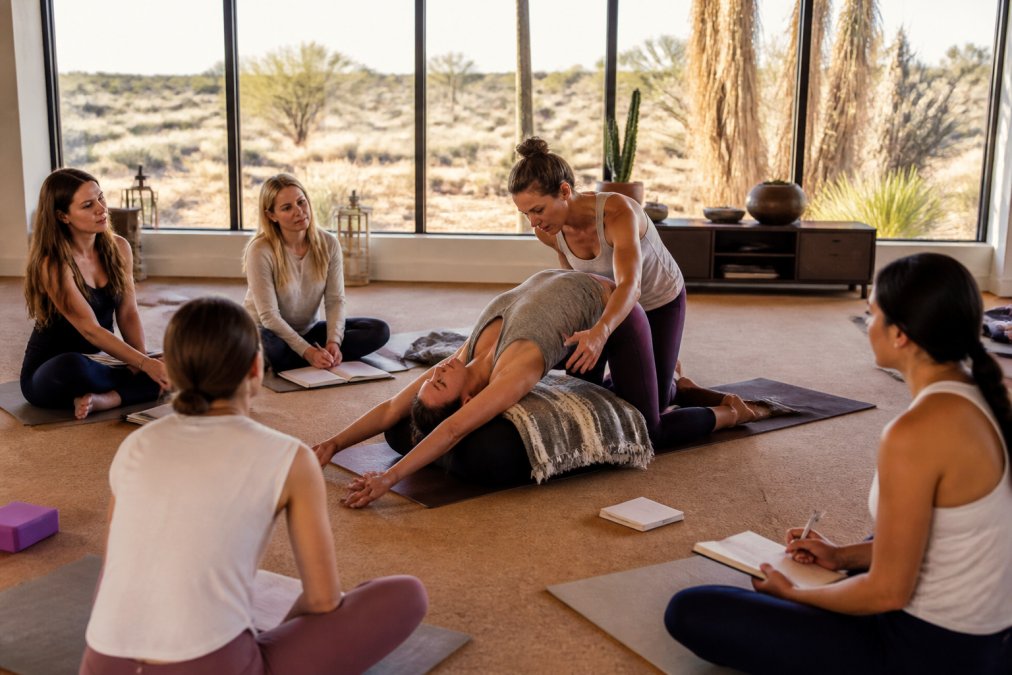
Practicum is where trainees actually teach, and it's the single best predictor of whether you'll feel ready on day one. Strong programs build in practice-teaching labs, peer feedback, and supervised hands-on adjustments.
What to Expect in 200 Hour Yoga Teacher Training
Expect a compressed, intense schedule with more reading and practice teaching than most trainees anticipate. Formats vary: weekend intensives, multi-week immersions, and hybrid learning models that pair virtual coursework with in-person hours. Online vs. in-person training is a real trade-off. Online programs offer flexibility and lower travel costs; in-person immersions build the tactile skill of reading a room.
A typical curriculum breakdown looks like this:
| Component | Typical Hours | What It Covers |
|---|---|---|
| Techniques and practice | 75-100 | Asana, pranayama, meditation |
| Teaching methodology | 20-30 | Cueing, sequencing, practicum |
| Anatomy and physiology | 15-25 | Body systems, contraindications |
| Philosophy and ethics | 20-30 | Texts, history, professional conduct |
| Electives and observation | 10-20 | Specialized topics, assisting |
The Real Costs of Certification (Including the Hidden Ones)
Tuition is only the visible cost. The number a school advertises is the entry point, not the total, and the gap between the two is where most budgets break. The honest answer on tuition is that it depends on the school, the format, and what's bundled in, so build your own cost sheet around the categories below and ask each program to fill it in before you commit.
The Cost Architecture: What You Pay For and When
Think of certification costs in three buckets, because they hit at different times.
One-time, pre-training costs
- Program tuition
- Application or registration deposits
- Required texts, manuals, and workbooks
- Props and mats you'll need for practice-teaching labs
- Travel and lodging if the program is immersion-based or held away from home
- Meals during residential immersions, if not bundled
One-time, post-training costs
- Initial registration with a registry such as Yoga Alliance, if you choose to register
- A background check, which some studios and gyms require before hiring
- Business setup if you'll teach independently, a separate bank account, a simple LLC filing in your state, and basic bookkeeping software
- Website, scheduling, and payment-processing tools if you're building your own client base
Recurring annual costs, the ones nobody warns you about
- Liability insurance, renewed annually for as long as you teach
- Registry renewal to keep your registered status current
- Continuing education units, which most registries require on a multi-year cycle
- CPR and first-aid certification, typically renewed every two years
- Platform considerations if you teach through a booking marketplace or studio software
Consumer protection guidance on service contracts
How to Read a Program's Cost Sheet
When you request a full cost sheet, ask these questions in writing:
- What is the total program investment, and does it include materials, manuals, and certification considerations?
- Is lodging included, and is it required or optional?
- Are meals included during residential portions?
- Is there a payment plan, and does it carry interest or fees?
- What happens to your program investment if you withdraw partway through?
- Does the program help you understand post-graduation considerations like insurance and registration?
The Comparison That Actually Matters
Two programs with the same program investment can have very different true considerations. A local weekend program with no lodging requirement may have a lower total investment than a destination immersion with a lower advertised price but mandatory travel, lodging, and meals. Compare programs on total investment for completion, program investment plus travel plus materials plus the first year of recurring considerations, not on the headline number.
Benefits of Yoga Teacher Training for Personal Growth
Self-practice deepens because you finally understand what you're doing and why. Sequencing knowledge changes how you move through your own body. The philosophy and ethics modules tend to surface questions people have been avoiding for years.
Career Reality: What 200 Hour Yoga Certification Actually Qualifies You For
A 200 hour certification qualifies you to apply for entry-level teaching positions, but it does not guarantee them. Studio hiring is competitive, and many markets have more certified teachers than open classes. Industry saturation is real, and it varies sharply by city and by niche.
Studio Hiring, Part-Time Gigs, and Industry Saturation
The honest picture: most new teachers start with part-time gigs, substitute slots, and community classes before landing a steady schedule. A full-time instructor role usually requires a 300-hour credential, a specialty, or a following you built yourself.
- Reliability. Can you show up on time, every week, and cover a class when someone calls out? New teachers lose gigs more often to flakiness than to weak sequencing.
- Fit with the existing schedule. Studios rarely have open prime-time slots. They have gaps, early mornings, mid-day, Friday nights, and they fill them with whoever says yes.
- A following. A teacher who brings ten students to a new time slot is worth more to a studio than a teacher who brings none. This is the single biggest lever a new teacher has.
The Business Reality Nobody Teaches You
Post-certification business reality is the gap most programs ignore. The moment you accept money for teaching, you are running a small business, and the work splits into two jobs: teaching, and everything that supports teaching.
The business job:
- Marketing, filling your own classes, not just showing up to someone else's
- Scheduling, coordinating with studios, subs, and your own calendar
- Understanding value, knowing what your time is worth and what your market will bear
- Client retention, turning drop-ins into regulars
- Administration, tracking income, expenses, and mileage for tax purposes
- Insurance and registration, keeping your credentials and coverage current
Niche ROI: Where Specialized Training Pays Off
Specialized training pays off more reliably than general teaching. Yin, restorative, trauma-informed sequencing, prenatal, and therapeutic applications all command more demand because fewer teachers hold those skills. Continuing education units toward a 300-hour credential are the standard next step, and they're where the return improves.
Burnout, Mental Health, and the Case for Choosing Your Training Carefully
Mental health matters here in two directions. A trauma-informed program teaches you to recognize when a student is dysregulated and how to respond. And it teaches you to protect your own capacity, which is what keeps teachers in the profession long enough to build something.
How to Evaluate a Yoga Teacher Training Program Before You Enroll
Evaluate a program on credentials, practicum hours, class size, and cost transparency, not on the beauty of the venue. Ask for the syllabus. Ask who teaches the anatomy block. Ask how many practice-teaching hours you'll actually log.
Use this checklist before you commit:
- Is the school registered with a recognized accrediting body?
- How many hours are dedicated to practicum and hands-on adjustments?
- What is the maximum class size?
- Are the lead trainers' credentials and teaching experience published?
- What is the full investment, including travel, materials, and insurance?
- Does the program include consent training for physical adjustments?
- Is there mentorship or support after graduation?
U.S. Department of Education guidance on selecting credential programs
Frequently Asked Questions
Can you teach yoga without a 200-hour certification?
Legally, most states don't require a license to teach yoga, so you can lead classes without certification. Practically, nearly every studio, gym, and wellness center asks for a 200-hour credential from a Yoga Alliance-registered school before hiring. Insurance providers also typically require proof of training before issuing liability coverage. Without certification, your options narrow to private clients, community centers, or informal settings, and you'll struggle to command standard class rates.
Is a 200-hour yoga certification enough to start teaching?
Yes, it's the entry-level standard for studio teaching in the U.S. A 200-hour program covers asana, pranayama, anatomy, philosophy, sequencing, cueing, ethics, and a supervised practicum, which meets the baseline most studios require. What it doesn't cover is business skills, niche specialization, or advanced adjustments. Many graduates teach part-time while pursuing continuing education units or a 300-hour certification to deepen their craft and raise their rates.
Is it worth doing a 200-hour YTT if I don't want to teach?
Many people enroll purely for personal transformation. The benefits of yoga teacher training for personal growth include a structured self-practice, deeper understanding of breathwork and meditation, and a supportive community that holds you accountable. You'll learn sequencing, cueing, and anatomy in ways that make your own practice safer and more intentional. If you're seeking mindfulness and spiritual growth rather than a career change, the training still delivers measurable value.
How do I know if a yoga teacher training program is reputable?
Check whether the school is registered with Yoga Alliance and whether its lead trainers hold RYT-500 or E-RYT credentials. Ask about curriculum standards: how many contact hours, how much practicum time, and whether hands-on adjustments and ethics are taught. Talk to past graduates about their experience. Visit the facility if possible. Programs that blend in-person immersion with hybrid learning and mentorship tend to produce more confident teachers than online-only options.
The challenge is that a 200 hour yoga certification only returns what you put around it: practice teaching, mentorship, and a specialty that sets you apart. At Blisstopia Retreats, our 200-hour and 300-hour Yoga Teacher Training programs run in a small-group sanctuary setting with on-site facilitators, trauma-informed sequencing, and integration modules built into the schedule. Reach out at 623-986-2899 to talk through whether certification fits where you are right now.