 how-to
How to Find Small Group Spiritual Retreats in Arizona
Table of Contents
- Why Small Group Retreats Beat Large Wellness Centers
- Step 1: Define Your Intentions for a Spiritual Retreat
- Step 2: Choose Your Arizona Desert Setting
- Step 3: Explore Small Group Desert Healing Retreats
- Step 4: How to Vet a Spiritual Retreat Facilitator
- Step 5: Understand the Faith-Based Wellness Ministry Arizona Option
- Questions to Ask Before You Book
- Your Next Step Toward a Transformative Experience
- Frequently Asked Questions
Last Updated: September 7, 2026
Searching for small group spiritual retreats in Arizona usually starts with a directory scroll and ends with a hard truth: most retreat centers are built for volume, not intimacy. A small group retreat is a private gathering where people move through a transformative experience together, with a facilitator who knows each name in the circle.
At Blisstopia Retreats, we host these gatherings on a secluded 2.5-acre sanctuary at the base of Sunrise Mountain near Peoria. Below, we walk you through exactly how to find a retreat that fits your intentions, your schedule, and your standards, in five steps: defining your purpose, choosing a desert setting, exploring your options, vetting the facilitator, and understanding the faith-based wellness ministry Arizona offers.
Why Small Group Retreats Beat Large Wellness Centers
The biggest difference comes down to attention. In a big program, you are one of dozens moving through a schedule. In a small group, the facilitator can track your energy, adjust the itinerary, and hold space for what surfaces during a breathwork session or a sound bath.
Small groups also change the dynamics. When you share a circle with ten people rather than fifty, the pressure to perform or hide dissolves. Vulnerability becomes safer, and the healing modalities feel less like a demonstration and more like a shared journey.
The trade-off is availability. Because small group retreats are limited by lodging and facilitator capacity, they book out further in advance. That scarcity is a feature, not a bug. It protects the therapeutic environment and keeps the experience high-touch from the first meal to the final closing circle.
Step 1: Define Your Intentions for a Spiritual Retreat
Before you search for how to find small group spiritual retreats in Arizona, get honest about what you are seeking. Are you carrying burnout so deep that you are questioning your career? Are you looking for self-love and inner peace after years of pouring into everyone else? Do you need stress reduction, or are you ready for spiritual awakening and soul exploration?
Write down your intention in one sentence. That sentence becomes your filter. When you read a retreat description, ask whether the wellness programs on offer serve that intention. A retreat centered on ecotourism and hiking will not meet you the same way as one built around guided meditation, energy healing, and contemplative practice.
Your timeframe matters too. A focused three-day container with daily practices can be highly effective. Decide how many days you can truly step away, then look for retreats that fit that window.
Step 2: Choose Your Arizona Desert Setting
The setting is more than a backdrop; it's a co-facilitator. But for a small group, choosing a location requires a logistical deep-dive that most retreat-finders skip. Here’s how to evaluate Arizona’s distinct regions through the lens of a group organizer.
The Region's Energy vs. Your Group's Needs
Arizona offers three primary desert energies, each with a different practical profile:
- Sedona's Red Rock Country: Famous for its vortex sites and dramatic canyon light, Sedona is the state's spiritual tourism hub. The energy is palpable, but the region is also a bustling tourist destination. For a small group seeking deep introspection, the constant influx of visitors can be a distraction. If you choose Sedona, prioritize retreat centers that offer seclusion on large properties, not just a room near Uptown.
- The Sonoran Desert Around Phoenix and Peoria: This landscape offers a quieter, more expansive feel with saguaro forests and mountain views. It's less about vortex energy and more about raw, open space. For groups, this can translate to a greater sense of privacy. The proximity to Phoenix is convenient for travel, but you must ensure the retreat property itself feels remote and disconnected from the city's pace.
- Southern Arizona (Tucson & Cochise Stronghold): This region is a haven for those seeking true solitude. The sky islands and rugged canyons of Cochise Stronghold offer a profound sense of isolation that is nearly impossible to find elsewhere. For a group whose intention is deep silence or vision-quest-style work, this is unmatched. The trade-off is distance from a major airport, adding a ground-transportation leg to your journey.
The Group Logistics Checklist
This is where most guides fail. They tell you a location is 'beautiful' but don't tell you how to get 12 people there and house them effectively. When you inquire about a venue, use this checklist:
- Ground Transportation: If your group is flying in, is the retreat center within a reasonable drive from Phoenix Sky Harbor International Airport (PHX) or Tucson International Airport (TUS)? For Sedona, that's a 2-hour drive from PHX (arizona-leisure.com). For the Peoria area, it's often under an hour. Does the venue offer airport shuttles, or will you need to coordinate multiple ride-shares or a large van?
- Single vs. Shared Occupancy: This is the most common point of friction for groups. A 'per-person' price often assumes double occupancy. Ask explicitly: What is the price difference for single occupancy? How many private rooms are available? For a true small group experience, having your own space for integration and rest is non-negotiable for many.
- Group Dining Dynamics: A private chef is a hallmark of a high-end retreat, and for a small group, the dining setup matters. Is there a communal table large enough for everyone to eat together? Can the kitchen accommodate complex dietary restrictions (e.g., gluten-free, vegan, paleo) for the entire group simultaneously?
- Dedicated Meeting Space: Your group needs a private, dedicated space for circle work, breathwork, or meditation that isn't a shared public area. Ask about the square footage, the flooring (is it carpeted or suitable for yoga mats?), and whether the space is exclusively yours for the duration of your stay.
- The 'Third Place' for Downtime: Beyond the formal practice space, where does the group go during unstructured time? Is there a living room with comfortable seating? A shaded outdoor patio? A fire pit? These 'in-between' spaces are where informal bonding and integration happen.
By evaluating the setting through this logistical lens, you ensure the beautiful landscape doesn't become a source of stress. The right venue is one where the practicalities fade into the background, allowing the desert and your group's work to take center stage.
Step 3: Explore Small Group Desert Healing Retreats
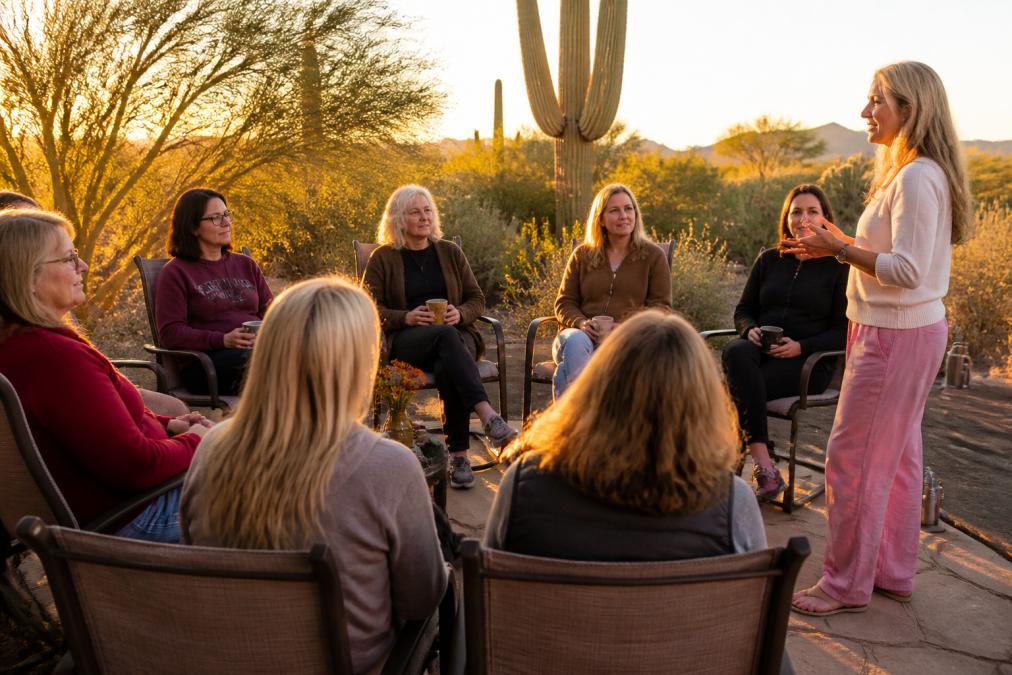
Small group desert healing retreats typically fall into three categories. The first is the pre-packaged program with fixed dates, a published itinerary, and a theme like surrender, grief, or women's empowerment. The second is the customized itinerary built around a private group that wants to work on a specific intention. The third is the facilitator-hosted retreat, where a visiting teacher rents a venue and brings their own community.
Each format suits a different situation. Solo travelers and couples usually thrive in pre-packaged programs because the group is assembled for them. Private groups of friends, families, or colleagues often prefer a customized itinerary so the content matches their shared history. Retreat facilitators looking for a venue need a space that offers group rentals with flexible hosting models. retreat style guide.
| Retreat Type | Best For | What to Expect |
|---|---|---|
| Pre-packaged program | Solo travelers, couples | Fixed dates, published theme, group assembled by host |
| Customized private retreat | Friends, families, teams | Itinerary built around your group's intentions |
| Facilitator-hosted retreat | Yoga teachers, coaches | Visiting leader rents venue, brings their own group |
When you find a retreat that looks promising, read the schedule closely. Look for a balance of structured practice and unstructured integration time. A retreat that runs from sunrise to sunset without breaks leaves no room for the nervous system to absorb the work. Effective small group desert healing retreats build in silence, rest, and time in nature alongside the breathwork, meditation, and ceremony.
Step 4: How to Vet a Spiritual Retreat Facilitator
The facilitator is the container for the entire experience. Here is a rigorous, safety-focused vetting framework designed for small groups, where the intimacy is high and the margin for error is low.
The Credential Audit: Look for the 'Why'
Don't just ask for a list of certifications; ask for the 'why' behind them. A facilitator's training should map directly to the modalities they are offering.
- For Breathwork: A certification in a specific modality (e.g., Transformational Breath®, Holotropic Breathwork™) is a start. But ask how their training addressed psychological safety. Breathwork can induce non-ordinary states of consciousness and emotional release. A facilitator should be able to articulate their protocol for a participant who experiences a strong emotional or somatic release.
- For Psychedelic or Plant Medicine Ceremonies: This is a high-risk area. If a retreat mentions 'plant medicine' or 'sacred ceremonies,' you must ask about their legal and medical framework (dea.gov). A legitimate facilitator will be transparent about their legal structure (e.g., operating under a religious exemption like a 508(c)(1)(a) ministry) and their medical screening process. They should have a clear protocol for medical emergencies and a relationship with a local emergency room. If they are vague or dismissive about legalities or safety, walk away immediately.
- For Yoga and Meditation: A 200-hour YTT is a baseline (yogaalliance.org). If the retreat is for 'trauma-informed' yoga, ask for specific training in that area. A standard YTT may not qualify someone to guide trauma processing.
The Group Dynamics Interview: Ask the 'What If' Questions
This is the most critical step. You are not just hiring a teacher; you are hiring a group facilitator. Ask these specific 'what if' questions and listen for the specificity of the answer:
- "What is your protocol if a participant has a panic attack during a session?" A good answer includes a specific, step-by-step plan (e.g., grounding techniques, one-on-one support, a safe room). A bad answer is 'I would hold space for them.'
- "How do you manage a participant who is monopolizing the group's time with their personal story?" A skilled facilitator has clear boundaries and techniques to redirect the group's energy.
- "What is your policy on participant-to-participant confidentiality?" In a small group, people share deeply. The facilitator must establish a strict confidentiality agreement at the start.
- "What is your scope of practice?" A facilitator should know what they are not qualified to do. They are not a therapist or a doctor, and they should say so. They should have a referral list of licensed professionals for participants who need ongoing support.
The Safety Protocol Checklist
Before you book, demand to see their written safety protocols. This is non-negotiable.
- Medical & Psychological Screening: Does the facilitator require a detailed intake form covering medical history, current medications, and psychological conditions? For high-intensity work like breathwork or plant medicine, this is essential.
- Emergency Plan: What is the plan for a medical emergency? Is there a first-aid kit on-site? How far is the nearest hospital? Is the facilitator CPR/First-Aid certified?
- The 'Shadow' Support: Who is on the facilitator's team? Is there a separate person to handle logistics and emergencies so the lead facilitator can stay present with the group?
- Insurance: Ask about liability insurance. A professional facilitator will carry it. This protects them, but more importantly, it signals that they take their professional duty of care seriously.
By moving beyond a simple credential check and into a rigorous interview and safety audit, you protect your group and elevate the potential for genuine transformation. You are not just finding a teacher; you are finding a skilled guide for a vulnerable journey.
Step 5: Understand the Faith-Based Wellness Ministry Arizona Option
A faith-based wellness ministry operates differently from a commercial spa or a resort, and understanding that distinction matters when you are searching for how to find small group spiritual retreats in Arizona. A ministry frames healing as spiritual growth and intentional living, not just relaxation. The practices may include prayer, meditation, energy healing, and ceremony alongside the yoga and breathwork.
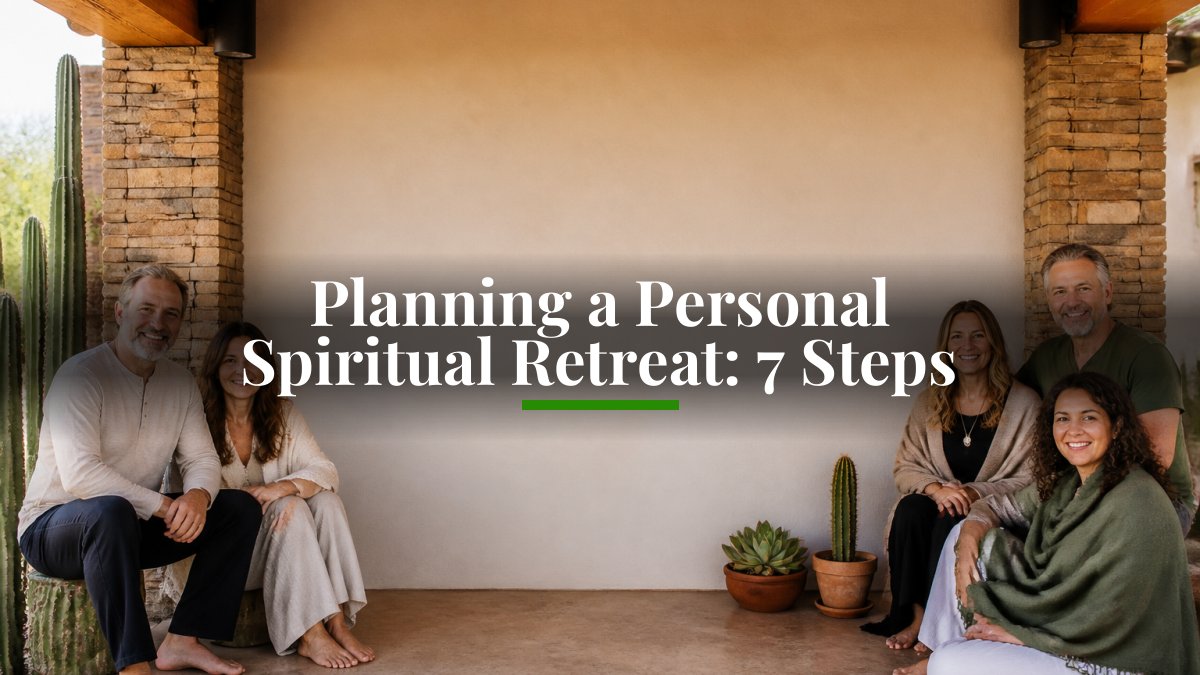
Blisstopia Retreats operates as a faith-based wellness ministry and private membership association in the Sonoran Desert near Peoria. Mark and Lana live on-site as full-time caretakers, which means guests have direct access to support. The sanctuary includes a fully equipped yoga studio, a pool with a waterfall, a hot tub, an infrared sauna, hiking trails, a natural labyrinth, and a fire ring, all set on secluded, off-grid acres.
For guests who are spiritual but not religious, the question is whether the faith component feels inclusive. A ministry can welcome seekers at every stage of belief. The framework can provide structure and depth, and the door can stay open. If you are unsure, ask the host directly how they handle guests with different beliefs. The answer will tell you whether you are walking into a judgment-free space or a conversion experience.
Questions to Ask Before You Book
A short list of screening questions will protect your investment and your peace of mind. Ask about the maximum group size and the facilitator-to-guest ratio. Ask what meals are included and whether the kitchen accommodates dietary restrictions. Ask what happens in an emergency, both medical and emotional. Ask whether the lodging is private or shared, and whether the retreat is truly all-inclusive or whether extras carry additional cost.
Pricing for private retreats varies widely based on length, lodging, meals, and the level of facilitation. Blisstopia Retreats custom-builds retreats from 3 to 14 days, and because they own their facility, they can offer a more accessible price without cutting quality. Reach out to any retreat you are considering for current pricing and a detailed breakdown of what is included.
Your Next Step Toward a Transformative Experience
Finding the right small group spiritual retreat in Arizona takes more effort than booking a hotel room, and that effort is exactly what makes the experience worth having. You are not looking for a place to sleep. You are looking for a container that can hold your healing, a facilitator who can guide it, and a group that can witness it.
If you are ready to explore what a private, faith-based sanctuary in the Sonoran Desert can offer, Blisstopia Retreats hosts its own transformational wellness retreats and partners with outside facilitators under several hosting models. Mark and Lana Royce live on-site, curate every stay for comfort and clarity, and welcome you as you are. To learn about upcoming retreats, availability, and enrollment, call them at 623-986-2899.
Frequently Asked Questions
How much does a small group spiritual retreat in Arizona cost?
Pricing for small group spiritual retreats in Arizona varies widely based on the length of stay, lodging-inclusive packages, and the level of customized programming. Luxury desert retreats and faith-based wellness ministries operate on different models. Instead of comparing advertised rates, ask for a detailed quote that lists accommodations, meals, and healing modalities. A private retreat center may offer a competitive all-inclusive rate. Contact the retreat directly for current pricing and what is included.
How do small group retreats differ from large-scale wellness centers?
Large wellness centers often run fixed schedules with dozens of guests, making personalized attention difficult. A small group retreat, typically 8 to 15 people, allows the facilitator to tailor meditation practice, breathwork, and healing sessions to the group's specific needs. You experience stronger group dynamics and a sense of safety that supports deeper personal work. The setting is often more secluded, which reduces distraction and supports a therapeutic environment. If you are working through burnout or spiritual growth, this intimacy usually produces a more transformative experience than a crowded program.
What should I look for in a faith-based wellness ministry in Arizona?
When evaluating a faith-based wellness ministry Arizona option, clarify how faith is integrated. A ministry should welcome your spiritual journey without forcing a specific doctrine. Look for on-site facilitators with verifiable credentials in counseling, yoga, or breathwork. Ask how they handle diverse beliefs and whether participation in ceremonies is optional. Confirm the size of the group and who leads each session. A ministry, operating as a private membership association, should be transparent about its structure and the background of its leadership.
What questions should I ask before booking a small group retreat?
Ask about the facilitator's training and years of experience, and request references or testimonials. Clarify the daily schedule, the number of participants, and the ratio of staff to guests. Inquire about the lodging and meals, and whether the itinerary can be customized. Confirm what happens if you have a medical or emotional concern during the retreat. Finally, ask about the location's privacy and seclusion, and what emergency procedures are in place, especially for a desert venue.